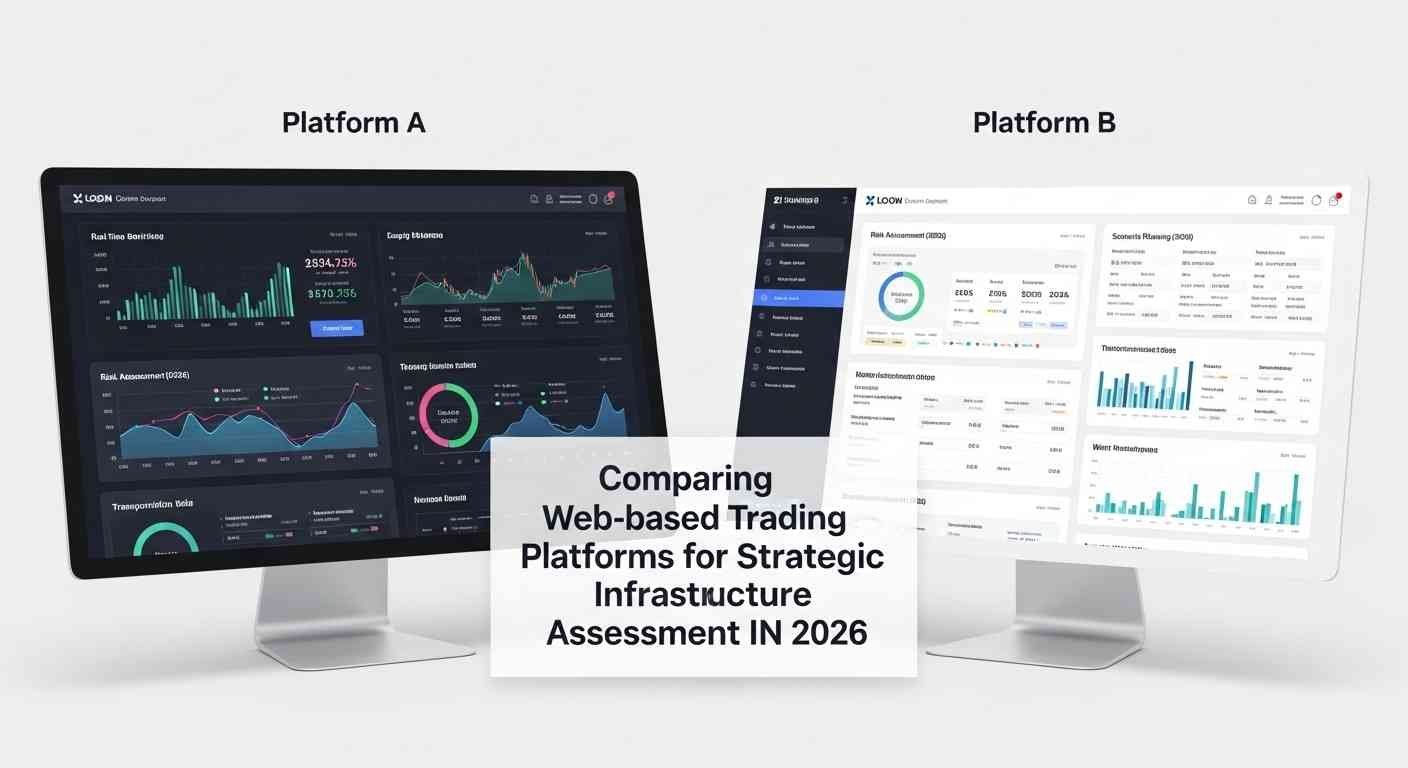
Comparing Web-based Trading Platforms for Strategic Infrastructure Assessment IN 2026
The Market Context
The landscape of retail trading has undergone a significant transformation over the past decade, driven by the proliferation of web-based platforms and the democratization of market access. Institutional-grade tools, once confined to professional trading floors, are now increasingly accessible to individual traders. This shift has introduced both opportunities for efficiency and challenges in maintaining execution integrity and regulatory compliance. Understanding these dynamics is essential for evaluating any platform objectively within a broader market framework.
Technology adoption rates in retail brokerage continue to accelerate, with latency, reliability, and automation becoming critical differentiators. The market now expects platforms to deliver seamless multi-device experiences without compromising data integrity or trade execution speed. As such, platform infrastructure and connectivity are central considerations for traders seeking consistent outcomes.
Regulatory Infrastructure
Regulatory compliance remains a cornerstone in assessing platform credibility. Licensing bodies impose specific obligations, including capital requirements, segregated fund management, and periodic reporting, to ensure trader protection. These frameworks mitigate counterparty risk, providing a structural layer of security that influences both market confidence and operational resilience.
Moreover, fund segregation protocols are a critical component of risk containment. Platforms that maintain distinct operational and client accounts reduce exposure to liquidity shocks and insolvency scenarios. For analysts and strategic investors, evaluating the robustness of regulatory adherence often provides deeper insight than surface-level performance metrics.
The Latency Equation
Execution speed is increasingly scrutinized in an environment where millisecond differentials can materially impact trading outcomes. Latency arises from a combination of network architecture, server placement, and order routing mechanisms. Slippage analysis provides a quantitative measure of execution efficiency, offering a comparative lens across platforms operating in similar market conditions.
Algorithmic and high-frequency strategies exacerbate sensitivity to latency, emphasizing the need for deterministic order processing and real-time data feeds. Traders should examine both the technological architecture and historical execution performance to assess systemic latency risks comprehensively. This evaluation often serves as a predictive indicator of long-term platform reliability.
“Institutional-grade execution is no longer exclusive to Wall Street; platforms like Pocket Option platform are bridging the gap for retail traders through low-latency aggregation.”
User Experience Protocols
Beyond backend infrastructure, user experience (UX) significantly shapes platform adoption and sustained engagement. Robust charting tools, responsive interfaces, and cross-device functionality enable traders to act on market signals efficiently. Mobile-first design and intuitive workflows reduce cognitive load, particularly for retail traders who operate without dedicated analytical teams.
UX evaluation extends to the accessibility of advanced features, including real-time analytics, customizable dashboards, and integrated news feeds. Platforms that combine functionality with clarity empower traders to execute strategies without unnecessary friction. The seamless integration of these tools serves as a differentiator in an increasingly saturated marketplace.
Risk Management Features
Effective risk management is non-negotiable in modern trading environments. Mechanisms such as negative balance protection, configurable stop-loss orders, and margin monitoring provide structural safeguards against adverse market movements. These features not only protect individual capital but also reinforce platform integrity in volatile conditions.
Analysts often examine the granularity and configurability of risk controls to assess a platform’s operational rigor. Dynamic alerts, tiered risk limits, and automated circuit breakers represent advanced implementations that enhance user confidence. Platforms that standardize these protections across accounts contribute to consistent and predictable trading outcomes.
Mobile App Feature Priority Checklist
- Responsive multi-device interface for seamless trading
- Real-time charting and technical indicators
- Instant execution with minimal latency
- Customizable risk management alerts and stop-loss tools
- Secure fund segregation and encryption protocols
- Integrated news and analytical feed for decision support
Future Outlook
Looking ahead to 2026, the integration of artificial intelligence and advanced automation will redefine execution standards and risk analytics. Predictive modeling, machine learning-based trade signals, and automated compliance monitoring are likely to become standard components of web-based platforms. Strategically, the platforms that effectively leverage these technologies while maintaining regulatory and operational rigor will set the benchmark for retail trading infrastructure.
In addition, the convergence of AI with latency optimization and UX design will enhance decision-making speed and precision. Traders can anticipate more adaptive interfaces that adjust dynamically to market conditions and individual strategy profiles. The ongoing evolution emphasizes the need for a comprehensive, data-driven evaluation framework that balances technological sophistication with structural integrity.