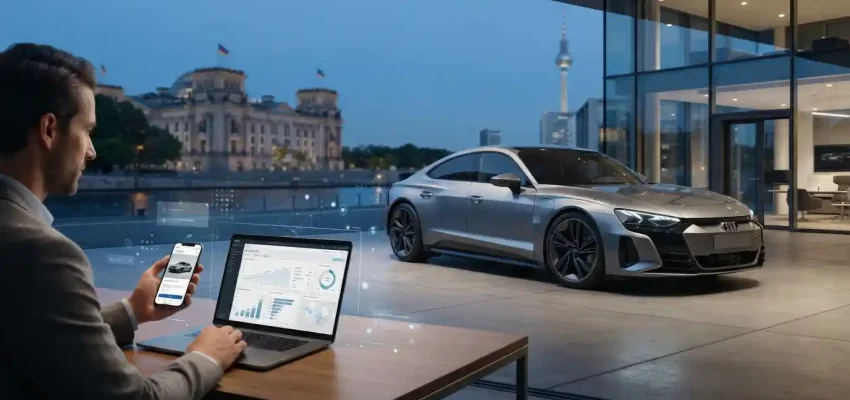

Berlin’s automotive market is entering a new digital era. The way people discover vehicles, compare models, evaluate dealerships, research electric mobility, and decide where to buy or service a car is changing rapidly. For automotive businesses, digital marketing is no longer simply a promotional channel. It is becoming part of the customer experience itself.
This transformation is happening within a wider German automotive industry that is adapting to electrification, software-defined vehicles, automation, and changing consumer expectations. For businesses operating in Berlin, the future will increasingly belong to companies that can combine strong automotive products with a smart, measurable, and customer-focused digital presence.
Why Digital Marketing Matters More for Berlin’s Automotive Market
Traditional automotive marketing depended heavily on dealerships, print advertising, outdoor campaigns, television, events, and word of mouth. These channels still have value, but modern customers often begin their vehicle journey somewhere else: online.
A potential buyer may search for a specific model, compare prices, watch a walkaround video, read customer reviews, investigate financing options, check charging information, or compare dealerships before ever contacting a sales representative.
This means automotive companies need to be visible throughout the entire decision-making process. A strong website alone is not enough. Businesses need a connected digital strategy covering search, content, social media, paid advertising, reputation management, email, analytics, and customer retention.
This broader approach is similar to the principles behind the global impact of digital marketing, where digital channels are increasingly integrated into wider business strategies rather than treated as isolated promotional tools.
The Rise of Search-Driven Automotive Buying
Search engines remain one of the most important starting points for automotive research. Consumers can search for terms related to new cars, used vehicles, electric vehicles, dealerships, repairs, financing, accessories, and local automotive services.
For a Berlin dealership, this creates an opportunity to compete for highly specific searches such as vehicle comparisons, electric car options, dealership locations, maintenance services, or questions about ownership costs.
Instead of producing generic advertising content, automotive businesses can build useful resources around the questions customers actually ask. Buying guides, comparison articles, maintenance explainers, EV charging guides, financing information, and model-specific content can all contribute to a stronger organic search presence.
Businesses can also learn from the broader principles of digital marketing benchmarking by measuring which channels generate qualified leads instead of focusing only on traffic or impressions.
Local SEO Will Become Even More Important
Automotive purchasing is often highly location-sensitive. Customers may search for a dealership near their home, a repair shop near work, an EV specialist in their district, or a service center that can handle a particular vehicle.
For Berlin automotive businesses, local SEO therefore deserves a central position in the marketing strategy.
A well-optimized local presence should provide accurate business information, clear service descriptions, useful location pages, customer reviews, photographs, opening hours, contact options, and relevant website content.
The objective is not simply to appear for broad automotive keywords. It is to become highly visible when a customer has a specific local need and is ready to take action.
Electric Vehicles Are Creating New Marketing Opportunities
Electric mobility is one of the biggest forces reshaping automotive marketing in Germany, and Berlin is an important market within that transformation.
In 2025, Berlin recorded 59,523 new passenger-car registrations, while vehicles with alternative powertrains accounted for 66.2% of new registrations. Pure electric and hybrid vehicles therefore represent an increasingly important part of the city’s automotive conversation.
For marketers, this means that EV customers need more than traditional vehicle advertising. They often have questions about charging, range, battery technology, ownership costs, public charging, home charging, maintenance, incentives, and everyday usability.
Content that answers those questions can attract customers earlier in the buying journey.
An automotive company could create articles explaining how to choose an electric car for city driving, how charging works, what factors affect real-world range, or how EV ownership differs from conventional vehicles. These resources can then support product pages and lead-generation campaigns.
The growing role of technology also connects naturally with topics such as new innovation in chipset development, particularly as vehicles increasingly depend on advanced computing, sensors, connectivity, and software.
Artificial Intelligence Will Change Automotive Marketing
Artificial intelligence is likely to become one of the most influential technologies in automotive marketing over the coming years.
AI can help businesses analyze customer behavior, identify patterns in campaign performance, personalize messaging, generate content ideas, automate routine communication, and improve lead qualification.
For example, an automotive dealership could use customer data to identify whether a visitor is primarily researching electric vehicles, family cars, performance models, commercial vehicles, or maintenance services. Marketing messages can then become more relevant to that customer’s interests.
AI can also support customer service through conversational tools that answer basic questions about inventory, service appointments, vehicle specifications, and dealership processes.
However, automation should not replace human expertise. Automotive purchases are often high-value decisions, and customers still need trustworthy information and access to knowledgeable professionals.
The most effective strategy will combine automation with human interaction rather than treating AI as a complete substitute for the sales process.
Social Media Is Becoming a Vehicle Discovery Channel
Social media has changed how automotive products are presented. A vehicle is no longer limited to a static showroom display. Brands can demonstrate features through short videos, demonstrations, customer stories, behind-the-scenes content, reviews, live events, and educational posts.
Platforms built around visual content are particularly useful for showing vehicle design, interiors, technology, performance, charging features, and lifestyle applications.
Berlin’s diverse population also creates opportunities for localized storytelling. Instead of relying exclusively on polished corporate advertising, automotive businesses can create content around real driving situations, city mobility, ownership questions, seasonal conditions, and local customer experiences.
This approach connects with broader strategies discussed in digital marketing’s global impact and can help brands develop a recognizable identity beyond conventional advertisements.
Video Marketing Will Influence Automotive Decisions
Automotive products are naturally suited to video. Customers want to see how a vehicle looks, how much interior space it offers, how its technology works, and what the driving experience might be like.
A strong video strategy can include:
- Vehicle walkaround videos
- Interior and technology demonstrations
- Electric vehicle charging explainers
- Model comparison videos
- Maintenance tutorials
- Customer testimonials
- Dealership introductions
- Short-form social media videos
These videos can then be distributed across multiple digital channels rather than being used once and forgotten.
Automotive marketers should also think about how video supports search visibility. Descriptive titles, useful transcripts, relevant landing pages, and strong supporting content can make video assets more discoverable and useful throughout the customer journey.
Data Will Make Marketing More Precise
Modern automotive marketing generates a large amount of behavioral data. Businesses can evaluate website visits, search queries, advertising interactions, form submissions, phone calls, email engagement, dealership visits, and completed purchases.
The challenge is turning those signals into useful decisions.
Instead of asking only how many people visited a website, marketers should ask which campaigns generated qualified leads, which pages helped customers move toward a purchase, which channels produced repeat customers, and where potential buyers abandoned the journey.
This is where concepts such as digital marketing for business services and advanced digital marketing for business growth become relevant to automotive organizations as well.
A data-driven automotive marketing strategy can continually adjust based on measurable customer behavior.
Personalization Will Improve the Customer Journey
Customers do not all want the same information. Someone researching a family SUV has different priorities from someone looking for a compact electric vehicle or a performance-oriented model.
Personalization allows automotive businesses to create different experiences for different customer segments.
For example, an EV-focused visitor could receive content about charging and battery technology, while a fleet customer could be directed toward operating costs, fleet management, and business-focused vehicle information.
Personalization can also continue after a purchase. Customers can receive maintenance reminders, service information, accessory recommendations, seasonal advice, and relevant ownership content.
This makes digital marketing part of customer retention rather than simply a tool for acquiring new buyers.
Online Reputation Will Directly Influence Sales
Reviews have become an important part of automotive decision-making. Customers can compare dealerships and service centers before deciding where to spend their money.
A business with strong advertising but poor customer feedback may struggle to convert digital traffic. Conversely, a dealership with a consistent reputation for transparent communication and quality service can turn positive customer experiences into an important marketing asset.
Automotive businesses should therefore actively monitor reviews, respond professionally to concerns, encourage genuine customer feedback, and use recurring complaints as signals for operational improvement.
Reputation management should be treated as part of the overall digital customer experience rather than as a separate public-relations activity.
Digital Marketing Will Connect Sales and After-Sales Services
The automotive customer journey does not end when a vehicle is purchased. Maintenance, repairs, inspections, accessories, software updates, tires, detailing, and other services can create long-term customer relationships.
Digital marketing can keep those relationships active through personalized email, service reminders, educational content, remarketing, loyalty campaigns, and targeted local advertising.
This creates opportunities to build recurring revenue rather than relying entirely on new vehicle sales.
Automotive service providers can also learn from specialized digital strategies such as digital marketing ROI for business services, where the focus is placed on measurable customer acquisition and retention.
Mobile-First Experiences Will Become Essential
Many automotive customers research products and services from smartphones. A slow or difficult mobile website can therefore create unnecessary friction at exactly the point when a potential customer is ready to learn more.
Automotive websites should make important actions easy to complete on mobile devices. Visitors should be able to view inventory, request information, call the dealership, find directions, book service, compare vehicles, and submit inquiries without navigating through unnecessary steps.
Mobile optimization should also extend to landing pages used for paid advertising. If an advertisement promises a particular vehicle or offer, the landing page should immediately deliver the information the user expected.
Digital Advertising Will Become More Data-Driven
Paid advertising can help automotive businesses reach customers quickly, but future campaigns will increasingly depend on data quality and audience relevance.
Instead of promoting the same advertisement to everyone, marketers can build campaigns around customer intent and lifecycle stage.
Someone searching for vehicle financing may need a different message from someone who has already visited a specific model page. Similarly, an existing service customer should not necessarily receive the same message as a first-time website visitor.
Effective campaigns will therefore combine audience segmentation, creative testing, conversion tracking, and continuous optimization.
Businesses interested in measuring these outcomes can apply lessons from strategic digital marketing ROI analysis and digital marketing ROI for consumer products.
The Automotive Website Will Become a Digital Showroom
The future automotive website will need to do much more than display a company address and a list of vehicles.
It should function as a digital showroom where customers can explore products, compare options, understand technology, calculate potential costs, view videos, read educational content, request information, and begin conversations with sales teams.
Strong websites will combine product information with helpful editorial content. A customer interested in electric vehicles might move from an educational article about charging to an EV comparison page and then to a vehicle inquiry form.
This type of connected architecture is one reason businesses should think about the cognitive user journey in digital transformation when designing their online customer experience.
Automotive Marketing Will Become More Omnichannel
The customer journey increasingly moves between channels. A person might discover a vehicle through social media, search for reviews on Google, visit a dealership website, watch a video, compare prices, receive a remarketing advertisement, and finally contact a salesperson.
These interactions should not feel disconnected.
An omnichannel strategy attempts to create a consistent experience across search, websites, social media, email, advertising, messaging, and physical dealerships.
Marketing teams therefore need to think beyond individual campaigns. The goal is to create a continuous customer journey where every interaction provides useful context for the next one.
Digital Marketing Will Help Smaller Automotive Businesses Compete
Digital transformation is not limited to major automotive manufacturers. Independent dealerships, workshops, detailers, parts suppliers, vehicle specialists, rental businesses, and mobility companies can also benefit.
A smaller company can compete through specialized expertise, strong local SEO, highly focused content, excellent reviews, fast customer service, and a clear niche.
For example, an independent Berlin workshop specializing in electric vehicles could build authority by publishing detailed EV maintenance guides and answering common customer questions. A specialist used-car dealer could develop content around vehicle inspections, ownership costs, and model comparisons.
This is particularly important as digital marketing becomes more competitive. Specialized expertise can give smaller businesses a stronger position than generic advertising alone.
Technology and Automotive Marketing Will Continue to Converge
The future of automotive marketing will be closely connected to the technology inside the vehicles themselves.
Software-defined vehicles, connected-car platforms, advanced driver assistance systems, artificial intelligence, cybersecurity, cloud services, and digital interfaces are changing what a vehicle represents.
Consumers increasingly need explanations of technology rather than simple lists of specifications. Marketing teams that can translate complex technology into understandable customer benefits will have an advantage.
The wider technology ecosystem represented by topics such as digital innovation and technology transformation, modern technology solutions, and technology-driven business innovation provides a useful parallel for understanding this shift.
What Berlin Automotive Businesses Should Do Now
The future does not require automotive businesses to adopt every new technology at once. A more effective approach is to build a strong digital foundation and improve it continuously.
Berlin automotive businesses should consider the following priorities:
- Build a strong local SEO presence: Make it easy for customers in Berlin to find relevant products and services.
- Create useful automotive content: Answer real customer questions instead of publishing generic promotional copy.
- Invest in video: Demonstrate vehicles, technology, services, and customer experiences visually.
- Improve mobile experiences: Make calls, inquiries, bookings, and vehicle research easy on smartphones.
- Use customer data responsibly: Measure behavior and personalize experiences without sacrificing trust.
- Strengthen online reputation: Encourage genuine reviews and respond professionally to customer feedback.
- Develop EV expertise: Create content and services around the growing electric mobility market.
- Measure ROI: Connect marketing activity with qualified leads, sales, service appointments, and customer lifetime value.
Businesses can also study broader performance frameworks such as digital marketing impact across industries and the economic impact of digital marketing in automotive markets to identify ways of connecting marketing activity with measurable business outcomes.
The Future Is Digital, but Trust Remains Central
Digital marketing is changing the automotive industry, but technology alone will not determine which businesses succeed.
Customers still want transparency, reliability, useful information, fair treatment, responsive service, and confidence in the people behind a brand. Digital tools simply give automotive companies new ways to demonstrate those qualities.
For Berlin’s automotive market, the opportunity is significant. As electric mobility grows, vehicles become more software-driven, customer journeys move further online, and data becomes more important, businesses that understand digital behavior will be better positioned to compete.
The future automotive marketer will therefore need more than advertising skills. Success will require an understanding of search behavior, content strategy, local visibility, data analytics, social media, artificial intelligence, customer experience, and automotive technology.
Berlin’s automotive sector is already moving in this direction. The companies that start building connected digital experiences now will be better prepared for a market where the customer journey begins long before the customer enters a showroom.