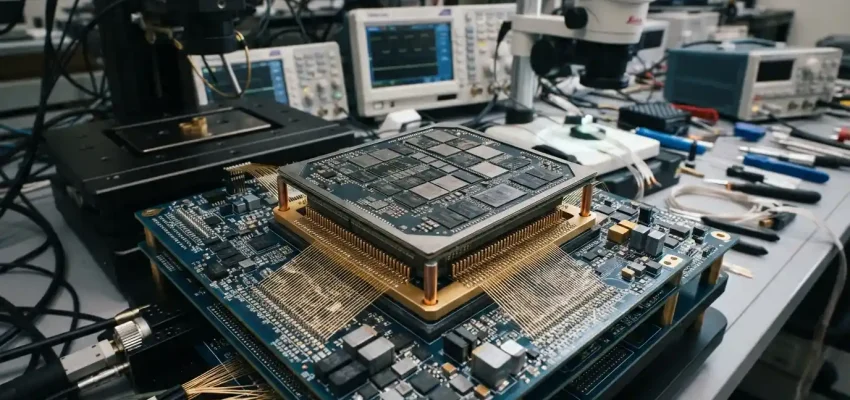

Chipset development is entering a new phase as semiconductor companies look beyond traditional transistor scaling and focus on advanced architectures, specialized processing, chiplets, advanced packaging, energy efficiency, and AI-focused computing. These innovations are changing how processors are designed for smartphones, computers, data centers, vehicles, industrial systems, and connected devices.
The latest new innovation in chipset development is not limited to making transistors smaller. Modern chip design increasingly combines improved transistor structures with modular architectures, dedicated accelerators, better memory integration, advanced power delivery, and sophisticated packaging techniques.
This evolution is particularly important as artificial intelligence and high-performance computing demand more processing power without allowing energy consumption, heat, cost, and physical size to increase at the same rate.
What Is Chipset Development?
Chipset development is the process of designing and engineering integrated circuits that manage computing, memory, communication, graphics, AI workloads, security, and other functions within an electronic system. Depending on the product, a chipset can contain CPUs, GPUs, neural processing units, memory controllers, connectivity components, security functions, and other specialized accelerators.
Modern system-on-chip designs increasingly integrate multiple computing functions into a single platform. At the same time, chiplet architectures are creating an alternative approach in which different processing components can be developed separately and combined within one package.
This modular direction is becoming increasingly important because designers can optimize individual components for specific workloads instead of treating the entire processor as one large piece of silicon.
1. Chiplets Are Changing the Architecture of Modern Processors
One of the most important innovations in chipset development is the growing use of chiplets. Instead of manufacturing every major function as part of one monolithic die, designers can divide a system into smaller dies that perform specialized functions.
Chiplets can contain compute cores, memory interfaces, accelerators, or input/output functions. These components can then be combined into a larger system package.
According to Arm, chiplets can improve design flexibility, allow different process nodes to be combined, and help reduce development costs and improve manufacturing yield. Arm’s Chiplet System Architecture is also designed to support standardized approaches to chiplet integration.
This trend is closely connected to the growing importance of semiconductor innovation across AI, cloud computing, consumer electronics, and high-performance computing.
For readers interested in broader technology developments, new chipset innovation is also closely related to topics covered in our technology development coverage.
2. Advanced Packaging Is Becoming as Important as Transistor Scaling
For decades, semiconductor progress was strongly associated with smaller transistor geometries. Today, advanced packaging has become another major source of performance improvement.
Modern packaging technologies can place multiple dies closer together and create faster communication between processing components. Techniques such as 2.5D integration, 3D stacking, silicon bridges, and hybrid bonding are helping designers build increasingly complex computing systems.
Intel, for example, describes technologies including Foveros and EMIB as important parts of its strategy for connecting multiple chiplets and scaling systems for demanding workloads such as AI.
Advanced packaging also makes it possible to combine components manufactured using different process technologies. That can give designers more flexibility when balancing performance, manufacturing cost, power consumption, and product requirements.
3. Smaller Process Nodes Continue to Matter
Transistor scaling remains an important part of chipset development even though it is no longer the only path toward better performance.
Leading semiconductor manufacturers continue to develop smaller and more efficient process technologies. TSMC reported that its 2nm technology entered high-volume manufacturing in the fourth quarter of 2025, while its roadmap includes additional nanosheet-based technologies and advanced power-delivery approaches.
Smaller process nodes can potentially increase transistor density and improve performance or energy efficiency. However, the benefits depend on the complete system design, including architecture, memory, packaging, software, and thermal management.
This is why modern chipset development increasingly combines process innovation with architectural innovation.
4. Gate-All-Around Transistors Improve Control
Another major development is the transition from FinFET transistor structures toward gate-all-around designs.
Intel’s RibbonFET architecture is one example of a gate-all-around approach. The design surrounds the transistor channel more completely with the gate, improving electrostatic control and supporting continued scaling.
Better transistor control can help chip designers pursue higher performance per watt while managing leakage and operating voltage. These improvements are especially valuable for mobile devices and AI systems where power efficiency is a major constraint.
5. Backside Power Delivery Is Reshaping Chip Design
Power delivery is another area receiving significant attention.
Traditional chip designs route power and signals through the same general side of the silicon. As transistor density increases, this can create routing congestion and make efficient power delivery more difficult.
Backside power delivery moves parts of the power network to the opposite side of the silicon. Intel’s PowerVia technology is an example of this approach and is designed to improve power distribution while freeing space for signal routing.
Better power delivery can become increasingly important as processors contain more cores and specialized accelerators.
6. AI Accelerators Are Becoming Central to Chipset Design
Artificial intelligence is one of the strongest forces influencing modern chipset development.
Instead of relying exclusively on general-purpose CPUs, modern systems increasingly incorporate specialized hardware for machine learning and AI inference. These accelerators can perform certain mathematical operations more efficiently than a conventional processor.
AI-focused hardware can include GPUs, neural processing units, tensor accelerators, and custom application-specific processing blocks.
The trend extends beyond large data centers. Smartphones, laptops, automobiles, cameras, industrial equipment, and edge devices increasingly require local AI processing.
This development connects directly with broader discussions about digital transformation, technology innovation, and technology solutions for modern businesses.
7. Heterogeneous Computing Is Expanding
Modern processors are increasingly heterogeneous, meaning they contain different types of computing resources optimized for different jobs.
A single platform might combine high-performance CPU cores, efficiency-focused CPU cores, GPUs, AI accelerators, image-processing hardware, security engines, and connectivity controllers.
This approach allows workloads to be assigned to the hardware best suited for them. Simple background tasks may run on low-power cores while demanding graphics or AI workloads are transferred to specialized accelerators.
The result can be better performance without requiring every part of the processor to operate at maximum power all the time.
8. Energy Efficiency Is Now a Core Design Goal
Performance alone is no longer enough to define a successful chipset.
Power efficiency is becoming equally important because higher computing workloads generate more heat and increase energy requirements. This is especially challenging for smartphones and thin laptops, where battery capacity and cooling space are limited.
Data centers face a different but equally important challenge. Large-scale AI systems can consume substantial amounts of electricity, making performance per watt a critical engineering metric.
Modern chipset developers therefore evaluate performance, power, thermal characteristics, memory bandwidth, and workload efficiency together.
9. Memory Integration Is Becoming More Sophisticated
Processor performance can be limited when computing cores have to wait for data. As a result, memory architecture is becoming an increasingly important part of chipset design.
High-bandwidth memory, larger caches, advanced memory controllers, and closer physical integration between memory and compute components can reduce bottlenecks.
For AI workloads, memory bandwidth can be particularly important because large models require processors to move significant quantities of data during computation.
This means the future of chipset development will involve not only faster processing cores but also better communication between compute, memory, and storage systems.
10. Security Is Moving Deeper Into Silicon
As chips become more connected and capable, hardware security is becoming a fundamental part of chipset architecture.
Modern processors can include dedicated security components for secure boot, cryptographic operations, trusted execution environments, key protection, and device authentication.
Hardware-based security can provide a stronger foundation than relying entirely on software because important security functions can be isolated at the silicon level.
This is particularly relevant for smartphones, connected vehicles, industrial systems, cloud infrastructure, and Internet of Things devices.
11. Chiplets Could Make Custom Silicon More Accessible
Custom silicon traditionally required substantial engineering resources and investment. Chiplets could change this model by allowing companies to reuse validated components rather than designing every part of a processor from scratch.
Arm’s chiplet strategy highlights how reusable compute components and standardized interfaces could support more flexible custom silicon development.
For technology companies, this could reduce development time and make specialized hardware more practical for particular workloads.
The concept also connects with the broader ecosystem of digital innovation, modern business technology, and technology-driven business solutions.
12. Semiconductor Design Is Becoming More Software-Driven
Software is increasingly involved in the development, verification, optimization, and operation of modern chipsets.
Electronic design automation tools help engineers model complex designs, verify functionality, optimize physical layouts, and analyze power and thermal behavior.
Artificial intelligence is also beginning to assist semiconductor engineers with design-space exploration and optimization. Recent research has examined AI and machine learning methods for advanced semiconductor packaging design, including thermal, electrical, mechanical, and reliability considerations.
As chip complexity increases, software tools will become even more important for controlling the engineering workload.
13. Connectivity Is Driving New Chipset Requirements
Modern chipsets increasingly need to support high-speed connectivity alongside computing.
Smartphones and computers require wireless communication, while vehicles, industrial equipment, and IoT systems may need multiple connectivity standards simultaneously.
This creates demand for integrated connectivity components that can deliver high performance without consuming excessive power or silicon area.
The broader technology ecosystem includes developments in digital cameras and imaging hardware, consumer gadgets, and gaming technology, all of which depend on increasingly capable semiconductor platforms.
14. Chipset Innovation Is Affecting Consumer Electronics
Consumers may not see the engineering inside a chipset, but semiconductor innovation directly affects everyday products.
Faster processors can improve application performance, gaming, photography, video processing, AI features, and battery efficiency. Dedicated hardware can also allow devices to perform advanced tasks locally instead of constantly sending data to remote servers.
This is one reason developments in consumer gadgets, digital imaging, and video game technology remain closely connected to semiconductor progress.
15. The Future of Chipset Development
The next generation of chipset development will likely involve multiple innovations working together rather than one technology dominating the industry.
Smaller transistor structures can increase density. Gate-all-around designs can improve transistor control. Backside power delivery can improve electrical distribution. Chiplets can provide modularity. Advanced packaging can connect multiple dies. AI accelerators can target specialized workloads. Improved memory architectures can reduce data bottlenecks.
These technologies can complement one another and create systems that are more powerful, efficient, scalable, and specialized.
Future processors may therefore be defined less by a single headline specification and more by how effectively their architecture combines different technologies.
What These Innovations Mean for Businesses
Chipset innovation is not only a hardware story. It can influence product development, operating costs, software strategies, data-center planning, and competitive positioning.
Companies developing AI products may require specialized accelerators. Manufacturers of connected devices may prioritize low-power processing. Automotive companies may require powerful computing platforms for advanced driver-assistance systems and software-defined vehicles.
Businesses exploring digital transformation can therefore benefit from understanding how semiconductor development influences the capabilities and limitations of modern computing platforms.
Related technology topics on our site include digital transformation, chipset innovation, technology innovation, business technology solutions, and technology-driven business development.
Key Takeaways
- Chipset innovation is moving beyond transistor miniaturization.
- Chiplets are creating more modular processor architectures.
- Advanced packaging is becoming a major source of performance improvement.
- Gate-all-around transistor designs are supporting continued scaling.
- Backside power delivery can improve power distribution and routing efficiency.
- AI accelerators are becoming essential in many computing platforms.
- Energy efficiency is increasingly important alongside raw performance.
- Memory architecture and bandwidth are becoming critical to overall system performance.
- Hardware security is being integrated deeper into modern processor designs.
- Software and AI-assisted engineering are becoming increasingly important in semiconductor development.
Final Thoughts
The new innovation in chipset development is best understood as a combination of technologies rather than a single breakthrough. Chiplets, advanced packaging, new transistor structures, improved power delivery, AI accelerators, memory innovation, and hardware security are collectively reshaping semiconductor engineering.
As computing demand continues to grow, the most successful chipsets will need to deliver more than raw processing power. They will need to balance performance, efficiency, scalability, security, thermal behavior, cost, and workload specialization.
That broader approach is likely to define the next generation of processors powering AI systems, smartphones, computers, vehicles, data centers, industrial platforms, and connected devices.