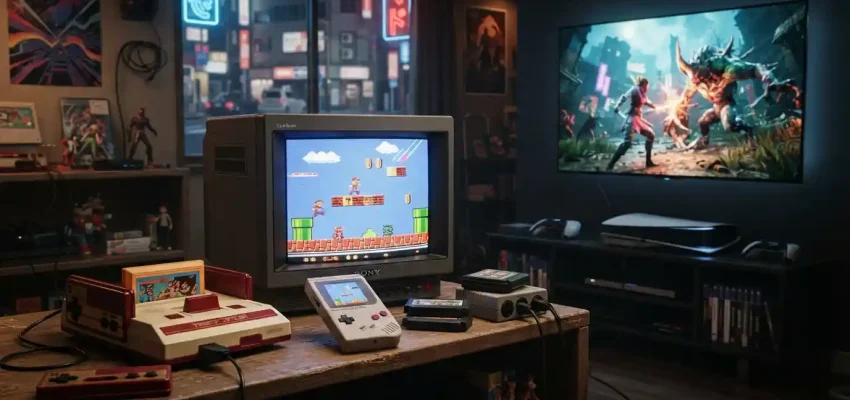

Japan did more than produce some of the world’s most recognizable video games. It helped define what modern gaming could be. From Nintendo’s revival of the home-console market to Sega’s arcade influence and Sony’s transformation of the PlayStation into a global entertainment platform, Japanese companies repeatedly changed how games were designed, played, marketed, and experienced.
The story is not simply about famous consoles. Japan’s influence extends across character design, game mechanics, handheld gaming, arcade culture, hardware innovation, role-playing games, 3D worlds, optical media, and the relationship between games and broader popular culture.
Today, many conventions that players take for granted can be traced to ideas developed or popularized by Japanese companies and creators. Understanding that history explains why Japan remains one of the most important countries in the evolution of video games.
Japan’s Early Role in the Rise of Video Games
Japan’s influence became particularly important during the late 1970s and early 1980s, when arcade gaming and home entertainment were developing rapidly. Japanese companies began treating games as a form of entertainment that could combine hardware engineering, visual design, music, storytelling, and repeatable gameplay.
Arcades became an important testing ground. Companies could experiment with controls, graphics, sound, difficulty, and competitive mechanics before bringing successful concepts into homes. This helped establish a design culture in which the feel of playing a game was just as important as the underlying technology.
The period also demonstrated something that would become a recurring theme in Japanese gaming: hardware and software were often developed as complementary experiences. Instead of treating a console as simply an electronic machine, companies increasingly designed systems around recognizable characters, distinctive controls, and carefully curated game libraries.
Nintendo Helped Rebuild the Home Console Market
One of the biggest turning points came with Nintendo’s Famicom, released in Japan in 1983. When the system reached North America in 1985 as the Nintendo Entertainment System, it arrived during a difficult period for the American video-game industry.
The Computer History Museum notes that the NES helped reverse the fortunes of the American game market after the 1983 crash. The system launched with 18 titles, while Nintendo’s later releases helped establish Mario as one of the most enduring characters in video-game history.
Nintendo’s impact was therefore larger than the success of one console. The company helped make the home console a trusted entertainment product again. It also demonstrated the power of strong first-party software and recognizable characters.
That philosophy can still be seen in modern gaming. Players frequently choose a platform because of its exclusive games, familiar franchises, controllers, or overall ecosystem rather than because of hardware specifications alone.
Mario Changed the Importance of Video Game Characters
Before Nintendo’s major global expansion, video games were often associated with machines, scores, and short arcade sessions. Nintendo helped move the medium toward character-driven entertainment.
Mario became more than a playable figure. He became a recognizable cultural character capable of appearing across multiple games and entertainment products. This approach established a model that countless publishers later followed.
Character identity also influenced how game worlds were designed. A memorable character could become the foundation for recurring mechanics, visual themes, merchandise, sequels, and new genres. The result was a stronger connection between players and the fictional worlds they explored.
This broader relationship between games and entertainment is also reflected in the site’s coverage of classic entertainment franchises, where recognizable characters and worlds continue to influence audiences across generations.
Sega Brought Arcade Energy Into the Home
Nintendo was not alone in shaping Japan’s gaming revolution. Sega developed its own identity around speed, arcade-style action, technical ambition, and competitive entertainment.
The Sega Mega Drive, known as the Genesis in North America, became an important competitor to Nintendo. According to the Computer History Museum, the Genesis was Sega’s most successful console, while Sonic the Hedgehog gave the company a character capable of competing with Mario’s popularity.
Sega’s approach helped establish a more aggressive console rivalry. Competition between Nintendo and Sega encouraged companies to invest in better graphics, faster gameplay, distinctive characters, sports titles, accessories, and more ambitious marketing.
The rivalry also showed that there was no single formula for successful console design. Different audiences could value different experiences, and companies had to build strong identities around their platforms.
Japanese Game Design Expanded Beyond Arcade Action
Japan’s contribution was not limited to platformers and arcade-inspired games. Japanese developers helped popularize genres that emphasized exploration, strategy, character development, long-form storytelling, and experimentation.
Role-playing games became particularly important. Developers created systems involving parties of characters, statistics, equipment, progression, exploration, and narrative choices. These mechanics encouraged players to spend dozens or even hundreds of hours with a single game.
Japanese design also demonstrated that games could appeal to different emotional experiences. A game could be challenging, humorous, mysterious, atmospheric, dramatic, or relaxing without abandoning interactive gameplay.
This philosophy helped expand the definition of what a video game could be and created opportunities for genres that continue to dominate the global industry.
The PlayStation Changed the Console Business
Sony’s entry into gaming created another major turning point. The company’s PlayStation project originally involved a collaboration with Nintendo around CD-ROM technology, but the partnership ended and Sony continued independently.
The original PlayStation launched in Japan in 1994 and reached North America in 1995. The Computer History Museum records that the system sold more than 100 million units and helped establish Sony as a dominant force in home gaming.
The PlayStation’s importance was partly technological. CD-based storage offered substantially more capacity than traditional cartridges, opening new possibilities for music, video, voice acting, larger environments, and cinematic presentation.
But the larger change was cultural. Sony positioned gaming as entertainment for a broad audience rather than something primarily associated with children. The PlayStation’s marketing, software library, and multimedia capabilities helped expand the demographic of console gaming.
Optical Discs Transformed Game Development
The transition from cartridges to optical discs changed what developers could put inside a game. The Computer History Museum describes Sony’s 1994 PlayStation as helping bring CD technology into the mainstream of the video-game industry.
More storage meant developers could experiment with full-motion video, recorded dialogue, orchestral music, larger soundtracks, and more detailed worlds. Games increasingly began to resemble interactive multimedia productions.
This shift also changed the economics of game publishing. Disc-based distribution could provide more storage at a different manufacturing cost structure, while the additional capacity encouraged publishers to create larger and more ambitious projects.
Japan Helped Push 3D Gaming Into the Mainstream
The 1990s were also the decade when three-dimensional gaming became a major part of the industry. Japanese companies played a central role in that transition.
Nintendo’s Super Mario 64 demonstrated how a major platforming franchise could be translated into a three-dimensional environment. Sony’s PlayStation helped make 3D graphics and disc-based games mainstream, while Sega also experimented heavily with new forms of three-dimensional gameplay.
The Computer History Museum identifies 3D graphics and optical-disc media as significant shifts in console technology during the 1990s.
These developments changed the way developers thought about space. Instead of moving primarily from left to right or around fixed arcade screens, players could navigate expansive environments, control camera movement, and explore worlds from multiple perspectives.
Handheld Gaming Became a Major Market
Japan also transformed portable gaming. Nintendo’s Game Boy demonstrated that a handheld system could become a long-term entertainment platform rather than a novelty product.
Portable gaming introduced a different relationship between players and games. A console was normally connected to a television and played in one location, while a handheld could travel with the player.
This idea eventually developed into increasingly sophisticated portable systems and later influenced hybrid concepts that blurred the boundary between home and handheld gaming.
The same broader Japanese approach to compact technology can be seen across other consumer electronics categories, including products discussed in budget-friendly gadgets and the site’s coverage of chipset innovation.
PlayStation 2 Turned Gaming Into a Multimedia Experience
Sony continued changing the role of the console with the PlayStation 2. Released in 2000, the system could play DVDs as well as games.
That decision helped position the console as a broader living-room entertainment device. The Computer History Museum notes that some consumers purchased the PS2 partly because its DVD functionality made it an attractive alternative to buying a separate DVD player.
This was an important lesson for the wider technology industry: a successful gaming platform did not necessarily need to be limited to gaming. Hardware could become more valuable when it served several entertainment needs.
Japanese Games Influenced Global Storytelling
Japanese developers also changed expectations around narrative. Games increasingly used recurring characters, dramatic music, elaborate fictional worlds, dialogue, cutscenes, and long-form storytelling.
Japanese role-playing games were especially influential in demonstrating that players could become emotionally invested in characters over long campaigns. Story was no longer merely an explanation for the next level; it could become a central reason to keep playing.
This influence spread globally as developers in North America and Europe adopted ideas involving character progression, cinematic presentation, branching narratives, party systems, world exploration, and detailed fictional histories.
Anime, Manga and Games Began Influencing One Another
Japan’s entertainment ecosystem created another advantage. Video games did not exist in isolation from animation, manga, toys, music, television, and film.
Characters and visual styles could move between mediums, while successful games could become anime series, films, merchandise, and other forms of entertainment. This created powerful feedback between different parts of Japanese popular culture.
That cross-media approach helped make certain franchises feel larger than individual games. Players could encounter the same fictional universe through multiple formats, strengthening brand recognition and audience loyalty.
Japanese Hardware Innovation Influenced the Global Industry
Japan’s gaming legacy is also closely connected to hardware engineering. Nintendo, Sony, Sega, and other Japanese companies repeatedly experimented with processors, storage formats, controllers, handheld designs, graphics capabilities, and alternative interfaces.
Not every experiment succeeded. Some technologies were discontinued, while others took years to find their audience. But experimentation became part of the industry’s development process.
The history of consumer technology shows a similar pattern: some ideas become standards while others serve as stepping stones toward better products. Articles such as Sony Alpha A6000 illustrate how Japanese electronics companies have continued developing products that combine compact hardware with sophisticated technology.
Japan Helped Make Gaming a Global Cultural Industry
Perhaps Japan’s greatest contribution was proving that video games could become a global cultural industry.
Nintendo created characters recognized across continents. Sega turned console competition into a major entertainment spectacle. Sony broadened the demographic and technological definition of console gaming. Japanese developers created genres and franchises that became permanent parts of international gaming culture.
The impact reached beyond the games themselves. Game music became commercially important. Character merchandise became a major business. Gaming conventions attracted international audiences. Japanese game design became a source of inspiration for developers worldwide.
Japan’s influence can also be seen in the way technology, entertainment, and consumer culture overlap. The site’s articles on Japan’s gaming history, interactive entertainment, and related technology topics can be viewed as part of this broader story.
Why Japan’s Influence Still Matters Today
Modern gaming is much more international than it was during the 1980s and 1990s. American, European, Korean, Chinese, and independent developers all play major roles in the industry.
Yet many of today’s conventions were shaped during Japan’s most influential gaming eras. Platform mascots, console exclusives, handheld systems, role-playing mechanics, character progression, cinematic games, arcade-inspired design, and multimedia consoles all have important connections to Japanese gaming history.
Modern technology has also made the boundary between games, mobile entertainment, streaming, social media, and other digital experiences increasingly fluid. The site’s discussion of digital transformation provides useful context for understanding how technology changes the way audiences interact with digital products.
The Lasting Legacy of Japanese Video Games
Japan changed video games forever because its companies and creators repeatedly expanded the medium’s possibilities.
Nintendo helped rebuild the home-console market and proved the commercial power of characters and first-party software. Sega demonstrated the value of arcade energy, speed, and direct competition. Sony helped transform consoles into sophisticated multimedia platforms and accelerated the industry’s move toward optical discs and broader audiences.
Japanese developers also helped establish genres, storytelling techniques, handheld gaming conventions, 3D design principles, and cross-media franchises that continue to influence developers around the world.
The result is an industry that looks very different from the arcade and cartridge era of the early 1980s. Yet traces of that period remain visible in almost every part of modern gaming.
Final Thoughts
Japan’s influence on video games was not the result of one console or one company. It came from decades of experimentation across hardware, software, characters, storytelling, business models, and entertainment culture.
From Famicom and Mario to PlayStation and 3D gaming, Japanese innovation repeatedly changed what players expected from interactive entertainment. That legacy remains one of the strongest foundations of the modern video-game industry.