A good range hood clears smoke, steam, grease, and cooking odors — protecting your cabinets, walls, and indoor air quality. Whether you are remodeling or replacing a builder-grade unit, understanding the range hood installation cost in USA homes helps you budget correctly. Total installed costs run $300 to $1,500 in 2026, with the range driven by hood type, ducting needs, and electrical work.
Range hoods are often an afterthought in kitchen projects, but they matter more than most homeowners realize. Cooking generates fine particulate matter, nitrogen dioxide (from gas stoves), and airborne grease that coats every surface. A properly sized and vented hood captures the majority of these pollutants. This guide covers costs, types, sizing, and installation details for American kitchens.
Average Range Hood Installation Cost in USA 2026
For a standard under-cabinet or wall-mount range hood with existing ductwork and electrical, installed cost runs $300 to $800. This covers the hood ($150 to $500 for the unit) plus 2 to 4 hours of labor at $75 to $150 per hour. It assumes a straightforward swap in the same location with compatible ducting.
Costs climb when new ductwork is needed ($200 to $600 additional), electrical must be run ($150 to $400), or you choose a premium island or professional-style hood ($800 to $2,500 for the unit alone). High-end installations with custom ducting, makeup air systems, or cabinet modifications can reach $2,000 to $4,000 total. For full kitchen projects, see kitchen remodel cost in USA 2026 for complete budgeting.
Cost by Hood Type
Under-Cabinet Range Hoods
The most common and affordable type, mounted beneath a wall cabinet over the range. Units cost $150 to $600; installed totals run $300 to $800 with existing ductwork. They are compact, effective for standard 30-inch ranges, and suit most American kitchens. Ductless (recirculating) under-cabinet models cost less to install ($200 to $500 total) since no ductwork is needed, but they filter rather than exhaust — less effective for heavy cooking.
Wall-Mount Chimney Hoods
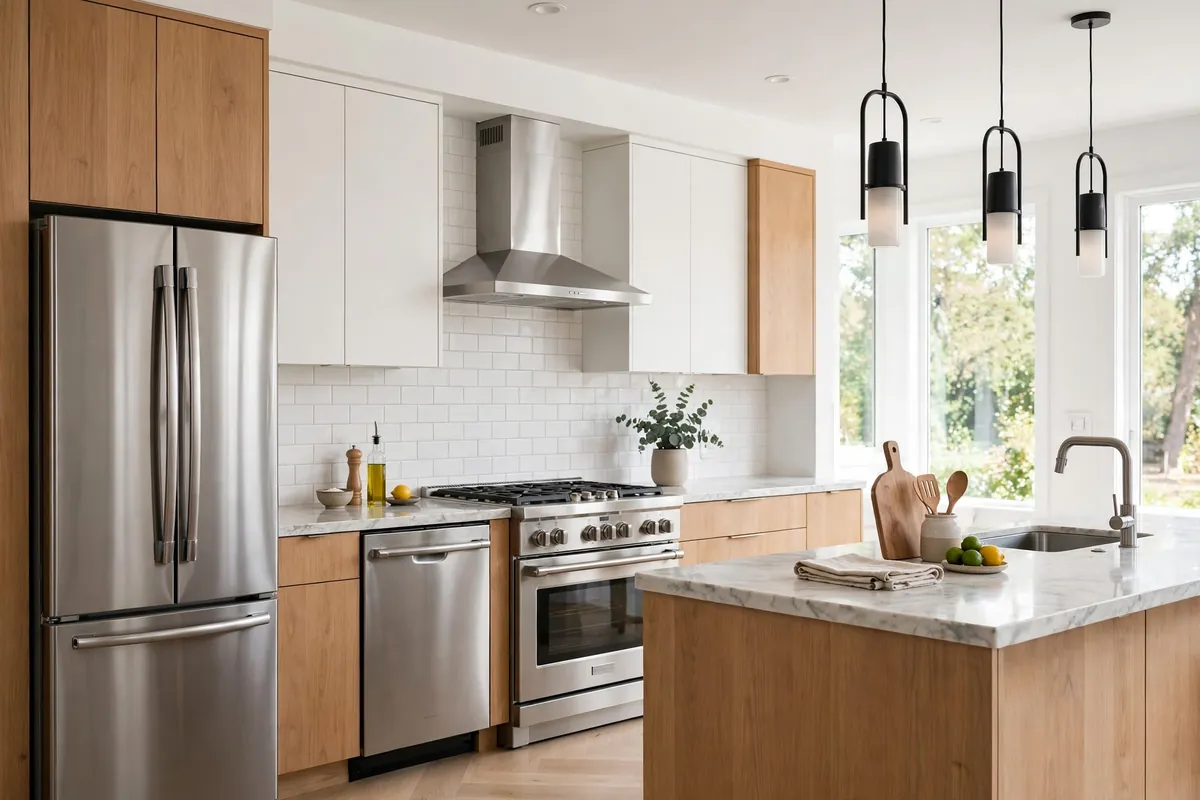
These statement pieces mount on the wall with a visible chimney covering the duct. Units run $300 to $1,200; installed costs are $600 to $1,500 with existing ducting. They suit kitchens without upper cabinets over the range and come in styles from sleek stainless to rustic wood-clad. Installation is more involved due to the chimney assembly and precise mounting requirements.
Island Range Hoods
Suspended from the ceiling over island cooktops, island hoods are the priciest common type: $500 to $2,000 for the unit, $1,000 to $2,500 installed. Ceiling mounting, longer duct runs through the ceiling, and electrical work drive costs up. They need higher CFM ratings because cross-drafts from open kitchen layouts reduce capture efficiency. If you are planning an island cooktop, our kitchen island installation cost USA guide covers the cabinetry side.
Downdraft and Insert Hoods
Downdraft systems retract into the countertop behind the cooktop ($500 to $1,500 installed) but are inherently less effective — heat and smoke naturally rise, fighting the downdraft. They suit island installations where overhead venting is impossible. Range hood inserts ($200 to $800 plus custom housing) hide inside a custom wood hood surround for a furniture look; the surround itself adds $500 to $2,000 in cabinetry costs. For custom woodwork budgets, see kitchen cabinet refacing cost USA.
Professional-Style Hoods
For pro-style ranges (36 to 48 inches), commercial-look hoods cost $1,000 to $3,500 for the unit, with installed totals of $1,500 to $5,000. They require high CFM (600 to 1,200+), larger ductwork (8 to 10 inches), and often makeup air systems per code. These are serious ventilation appliances for serious cooks — and serious budgets.
Sizing: CFM Requirements
CFM (cubic feet per minute) measures how much air the hood moves. Undersized hoods are the most common range hood mistake in American homes — a pretty hood that cannot clear smoke is decoration, not ventilation. Size correctly using these rules.
For standard cooking on a 30-inch range, you need at least 100 CFM per linear foot of cooktop width — 250 CFM minimum for a 30-inch range. Gas ranges need more: roughly 1 CFM per 100 BTU of burner output. A typical 4-burner gas range (40,000 to 60,000 BTU total) needs 400 to 600 CFM. Pro-style ranges with 100,000+ BTU need 1,000+ CFM. Island hoods need about 50 percent more CFM than wall hoods due to cross-drafts.
Bigger is not always better: hoods over 400 CFM may require makeup air systems under the International Residential Code adopted in most US states. Makeup air replaces the air the hood exhausts, preventing backdrafting of furnaces and water heaters — a safety issue, not just comfort. Makeup air dampers add $200 to $600 to the project. Your installer should evaluate this; it is not optional where code requires it.
Ducted vs Ductless
Ducted hoods exhaust air outside through rigid metal ductwork — the gold standard for effectiveness. They remove heat, moisture, grease, and pollutants completely. If your kitchen has existing ductwork in good condition, always choose ducted. New duct installation adds $200 to $600 but pays off in performance.
Ductless (recirculating) hoods filter air through charcoal and grease filters, then blow it back into the kitchen. They capture grease and some odors but do not remove heat, moisture, or combustion pollutants. They are acceptable where ducting is impossible (apartments, condos with restrictions) but a compromise everywhere else. Charcoal filters need replacing every 3 to 6 months ($15 to $40 each) — factor this ongoing cost into your decision.
Ductwork rules: use rigid metal duct (never flexible), keep runs as short and straight as possible, size correctly (6-inch minimum for most hoods, 8 to 10 inches for high-CFM units), and vent through the roof or wall — never into an attic or crawl space. Every elbow reduces effectiveness; two 90-degree bends can cut airflow by 25 percent.
Electrical Requirements
Most range hoods need a dedicated 15-amp, 120-volt circuit. If your old hood was hardwired, the new one can usually use the same connection. Converting from a plug-in microwave-hood combo to a hardwired hood may require an electrician ($150 to $300).
Some high-CFM or feature-rich hoods (with heat lamps, warming shelves) need 20-amp circuits. Your installer should verify the circuit can handle the load — an overloaded circuit trips breakers annoyingly. See how to troubleshoot a tripped breaker USA if you have ongoing electrical issues in the kitchen. All electrical work must meet local code; permits are required in most jurisdictions for new circuits.
Installation Process: What to Expect
A standard replacement takes 2 to 4 hours. The installer removes the old hood, verifies or installs ductwork, makes electrical connections, mounts the new hood at the correct height, connects the duct, and tests operation. Standard mounting height is 24 to 30 inches above electric cooktops and 28 to 36 inches above gas — check your hood’s manual, as too low restricts access and too high kills capture efficiency.
New installations (no existing hood) take 4 to 8 hours and may span two trades: an HVAC or handyman contractor for ductwork and mounting, plus an electrician for the circuit. Coordinate both before demolition day. If cabinets need modification to fit the hood or chimney, add a carpenter to the team. For contractor selection principles, see how to choose a kitchen contractor USA.
Factors That Affect Total Cost
Ductwork condition: Reusing sound existing ducts saves $200 to $600. Damaged, undersized, or flexible ducts should be replaced — do not connect a good hood to bad ducting.
Kitchen layout: Island installations cost 50 to 100 percent more than wall installations due to ceiling work. Second-floor kitchens with attic access above are easier (and cheaper) than first-floor kitchens needing long duct runs.
Permits: Most US jurisdictions require permits for new ductwork penetrations and electrical circuits ($50 to $200). Reputable installers pull permits; unpermitted work can complicate home sales and insurance claims.
Makeup air: Required by code for high-CFM hoods in most states. Budget $200 to $600 for the damper system and installation.
Maintaining Your Range Hood
Clean grease filters monthly — most are dishwasher-safe. Soak stubborn filters in hot water with degreasing dish soap. Replace charcoal filters in ductless models every 3 to 6 months. Wipe the hood exterior weekly to prevent grease buildup that becomes difficult to remove. Check the exterior vent cap annually for blockages.
Neglected filters restrict airflow, forcing the fan to work harder while capturing less — the same efficiency death spiral as dirty refrigerator coils. A few minutes of monthly maintenance keeps your hood performing like new for its entire 10- to 15-year lifespan. This is basic extend appliance lifespan USA practice applied to ventilation.
Frequently Asked Questions
How much does it cost to install a range hood?
Standard under-cabinet or wall-mount installation with existing ductwork costs $300 to $800 in the USA. Island hoods run $1,000 to $2,500 installed. New ductwork adds $200 to $600; new electrical adds $150 to $400. Premium and pro-style installations can reach $2,000 to $5,000.
What size range hood do I need?
For a 30-inch range, minimum 250 CFM; for gas ranges, roughly 1 CFM per 100 BTU of total burner output (typically 400–600 CFM). Island hoods need about 50 percent more than wall hoods. Hoods over 400 CFM usually require makeup air systems per code.
Are ductless range hoods worth it?
They are a reasonable compromise where ducting is impossible (rentals, condos), but they do not remove heat, moisture, or combustion gases — only grease and some odors. Wherever ducting is feasible, a ducted hood performs dramatically better. Factor in $60 to $160 per year in replacement charcoal filters.
How high should a range hood be mounted?
Typically 24–30 inches above electric cooktops and 28–36 inches above gas cooktops. Always follow the manufacturer’s specifications for your specific model — mounting too high destroys capture efficiency, while too low creates a fire hazard and blocks access.
Do I need a permit to install a range hood?
Most US jurisdictions require permits for new ductwork roof/wall penetrations and new electrical circuits. Simple like-for-like replacements using existing duct and wiring often do not. Check with your local building department — your installer should handle permits as part of the job.
Understanding the range hood installation cost in USA homes helps you invest wisely in one of the kitchen’s hardest-working appliances. Size the CFM correctly, choose ducted wherever possible, budget for the ductwork and electrical honestly, and maintain the filters. Do that and your hood will protect your kitchen’s air, surfaces, and your family’s health for 15 years. For broader kitchen planning, explore kitchen lighting design guide USA and kitchen remodel cost in USA 2026. If cooking ventilation has you thinking about your whole kitchen’s air quality, our how to improve indoor air quality USA guide covers the complete picture.