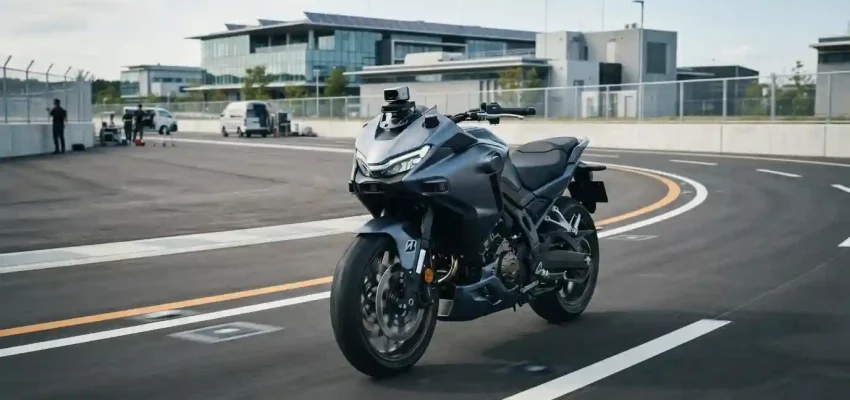

Honda has been exploring a future where motorcycles can do more than simply respond to a rider’s steering input. Recent and earlier Honda patents reveal how the company has investigated steering assistance, self-balancing technology, sensors, and automated control systems designed to make motorcycles more stable and potentially safer in difficult situations.
The idea of a self-steering motorcycle may sound futuristic, but Honda has already demonstrated working self-balancing motorcycle concepts. Its Riding Assist technology uses electronic control of steering and other vehicle dynamics to help keep a motorcycle upright, particularly at low speeds and when stationary.
More recent patent work has expanded the concept toward active steering assistance. Some designs describe motorcycles capable of detecting hazards, assessing the rider’s presence and controlling steering, braking or acceleration under specific circumstances.
That does not mean Honda is preparing to release a completely autonomous motorcycle. Patents describe possible technologies rather than confirmed production features. However, they provide a useful look at where motorcycle safety and rider-assistance technology could be heading.
What Does Honda’s Self-Steering Motorcycle Patent Show?
One Honda patent describes a motorcycle equipped with a steering actuator capable of actively controlling the front wheel. The system can work with sensors and electronic control units to determine the motorcycle’s condition and apply steering assistance when specific circumstances occur.
One particularly unusual application involves a motorcycle that has been involved in an accident while continuing to move without its rider. The patent describes systems capable of determining whether a collision occurred and whether an occupant remains on the motorcycle.
If the motorcycle is still traveling without a rider, automated control could potentially guide it away from obstacles or pedestrians and reduce the possibility of secondary damage.
This approach is different from conventional motorcycle safety technology because the system does not simply warn the rider. Instead, the proposed technology can intervene directly through the motorcycle’s steering system.
How Could a Self-Steering Motorcycle Work?
A motorcycle cannot safely steer itself using a single sensor. Maintaining stability requires information about the motorcycle’s position, movement, surroundings and rider inputs.
Honda’s technology research has therefore involved combinations of electronic control systems, inertial sensors, steering sensors and environmental sensing technology.
Steering Actuator
The steering actuator is one of the most important components. It provides the mechanical ability for an electronic control system to influence the motorcycle’s steering angle.
Honda has previously researched steering-assist systems using actuators that can apply steering torque based on the motorcycle’s operating condition. Earlier Honda patent documentation describes an actuator that provides steering torque and a control system that calculates an appropriate target torque.
Gyroscope and Inertial Sensors
Motorcycles constantly change their orientation while riding. Gyroscopes and inertial measurement systems can help determine movement, lean and acceleration.
Honda’s Riding Assist research specifically describes the use of an inertial measurement unit containing acceleration and gyro sensors, together with steering-angle information.
Camera, Radar and LiDAR
Environmental awareness becomes particularly important when a motorcycle is expected to react to obstacles.
Patent-related reporting on Honda’s self-steering concepts has described combinations of cameras, radar and LiDAR. These technologies can help a vehicle identify objects and understand the environment around it.
Camera systems can provide visual information, radar can detect objects and their movement, while LiDAR can contribute additional distance and environmental data. Combining these inputs can give an electronic control system more information than any individual sensor could provide.
Honda Has Already Demonstrated Self-Balancing Motorcycle Technology
The concept of a motorcycle controlling its own balance is not new for Honda.
Honda introduced its Riding Assist technology at CES 2017. The company explained that the system was designed to reduce the possibility of a motorcycle falling over while stationary and to demonstrate how robotics technology could be applied to motorcycles.
Honda’s later technology development continued to investigate autonomous control. According to Honda’s own technical explanation, its system can use front-wheel steering and changes in motorcycle dynamics to maintain balance at low speeds or while stationary.
This development is important because self-balancing and self-steering are closely connected. A motorcycle that can automatically adjust its steering to maintain balance already contains some of the fundamental technology needed for more advanced rider assistance.
Self-Steering Does Not Necessarily Mean Fully Autonomous Riding
There is an important difference between a motorcycle that can assist steering and one that can ride completely without a human.
Honda’s patents and technology demonstrations generally point toward assistance rather than eliminating the rider altogether. The motorcycle can use electronic systems to support stability, react to certain hazards or influence steering while the rider remains part of the control system.
This approach could be more practical than attempting to create a completely autonomous two-wheeled vehicle.
Unlike a car, a motorcycle must manage balance, lean angle, rider movement and steering dynamics simultaneously. A system that assists the rider during specific situations may therefore offer a more realistic path toward advanced motorcycle automation.
Could Honda’s Technology Help Prevent Motorcycle Crashes?
Potentially, yes, although a patent should not be interpreted as proof that a production motorcycle will prevent crashes.
Honda’s more recent steering-assistance concepts illustrate how sensors and automated steering could potentially intervene when a dangerous situation is detected. Such technology could complement existing motorcycle safety systems rather than replace them.
Modern motorcycles already use technologies such as anti-lock braking systems, traction control and electronic engine management. Active steering assistance could eventually become another layer of protection.
The most useful application may be situations where a rider has limited time to react. A system that can recognize an approaching obstacle and provide a small steering correction could potentially help the rider avoid a collision while still leaving the rider in control.
Why Steering Assistance Is So Challenging on a Motorcycle
Motorcycle steering is fundamentally different from steering a conventional car.
A motorcycle changes direction partly by leaning. The steering system must therefore work with the motorcycle’s speed, lean angle, road surface, rider input and overall vehicle dynamics.
An automated steering correction that would be harmless in a car could have much greater consequences on a motorcycle.
For this reason, any self-steering system needs to distinguish between intentional rider movements and situations where intervention is genuinely necessary.
Honda’s Earlier Steering-Assistance Patents Matter
Honda has been researching electronically assisted motorcycle steering for years. One Honda patent for a steering-assist system describes an actuator that provides steering torque and a control unit that determines target torque according to the motorcycle’s state.
That history shows that Honda’s current research is not an isolated experiment. Instead, it appears to be part of a longer development path involving motorcycle stability, electronic steering assistance and automated vehicle control.
The evolution resembles other technology categories where individual systems gradually become integrated into larger driver-assistance platforms. Developments in chipset innovation and electronic control can eventually support increasingly sophisticated vehicle systems.
What Sensors Could Make the Technology Smarter?
A future rider-assistance motorcycle could potentially combine several data sources rather than relying on one technology.
- IMU: Measures acceleration, rotation and changes in vehicle motion.
- Steering sensors: Detect steering angle and rider input.
- Camera: Provides visual information about vehicles, road conditions and obstacles.
- Radar: Helps detect nearby objects and their movement.
- LiDAR: Can provide detailed distance and environmental information.
- GPS: Can support navigation and location-based assistance.
- Electronic control units: Process sensor information and determine how the motorcycle should respond.
These technologies fit into a broader trend toward intelligent mobility. Readers interested in related developments can also explore the site’s coverage of modern gadgets and technology and IT and technology developments.
Could Self-Steering Become a Production Motorcycle Feature?
It is possible, but patents alone cannot establish a production timeline.
Manufacturers frequently patent technologies for research, protection of intellectual property and future product planning. Some patented ideas eventually appear in production vehicles, while others remain experimental.
Honda’s existing Riding Assist demonstrations make the company’s interest in motorcycle stability clear. The next step could involve integrating selected forms of steering assistance into motorcycles where the technology can provide measurable safety or convenience benefits.
The automotive industry is already moving toward increasingly intelligent driver-assistance systems. Honda’s motorcycle research suggests that similar principles could eventually become more common on two wheels.
What Could Self-Steering Mean for Motorcycle Safety?
If the technology becomes reliable enough for production use, it could create several possible safety benefits.
Emergency Steering Assistance
The system could potentially provide a small steering correction when sensors identify an immediate collision risk.
Low-Speed Stability
Automated steering could help maintain balance during slow-speed maneuvers, parking or stop-and-go situations.
Post-Crash Control
A motorcycle that remains upright and moving after a rider has fallen could potentially be guided away from pedestrians, vehicles or other hazards.
Reduced Rider Workload
Future systems could assist with selected riding tasks while preserving the rider’s ability to control the motorcycle.
How This Fits Into the Future of Motorcycle Technology
Self-steering is only one part of a much larger transformation in motorcycle technology. Electronic clutches, advanced rider assistance, connected vehicles and increasingly powerful onboard computing are changing what motorcycles can do.
Honda’s own E-Clutch technology, for example, demonstrates how electronic control can automate part of the riding process while still allowing the rider to remain involved.
The development of intelligent motorcycle systems also connects with wider technology trends. Honda’s history of combining robotics research with vehicle engineering demonstrates how advances in computing and sensing can influence transportation.
Technology enthusiasts can also explore related topics such as digital camera technology, Japan’s influence on video-game technology, and digital transformation to understand how electronics and software continue to reshape everyday products.
Could a Self-Steering Motorcycle Ride Without a Rider?
Some Honda patent concepts specifically consider situations in which a motorcycle continues moving after the rider has been separated from it. However, this should not be confused with a fully autonomous motorcycle designed for everyday riderless transportation.
The purpose described in the relevant patent reporting is primarily to reduce secondary damage after an accident. If the motorcycle remains upright and continues traveling, automated steering and speed control could potentially move it away from people and obstacles before bringing it to a stop.
That is a very different goal from creating a motorcycle that independently navigates roads without a rider.
What Are the Biggest Challenges?
Several engineering and regulatory challenges would need to be addressed before advanced self-steering systems could become widespread.
- Accurately interpreting complex road environments
- Distinguishing rider intent from emergency conditions
- Preventing unwanted steering intervention
- Maintaining stability across different speeds
- Handling rain, poor visibility and unusual road surfaces
- Ensuring sensors remain reliable
- Testing safety systems under thousands of real-world conditions
- Meeting regulatory and liability requirements
These challenges are similar to those facing other intelligent vehicle technologies. Developments in automotive technology and digital systems show how software increasingly influences physical transportation systems.
What Motorcycle Owners Should Expect
Motorcycle owners should not expect current Honda motorcycles to suddenly become completely autonomous because of these patents.
Instead, the patents should be viewed as evidence of continuing research into rider assistance, stability and safety. Production technology will depend on engineering validation, cost, reliability, regulation and Honda’s product strategy.
For riders, the most meaningful development would likely be technology that works quietly in the background. A system that assists only when necessary could offer additional protection without changing the fundamental experience of riding.
Related Vehicle Technology Worth Watching
The broader AnchorEra technology and automotive coverage provides several related areas for readers interested in intelligent transportation. These include modern automotive service technology, vehicle maintenance and auto care, automotive service developments, and vehicle safety and maintenance.
Readers can also compare developments in emerging personal transportation through coverage of electric motorcycle legality and related road-use questions.
Final Thoughts
Honda’s self-steering motorcycle patents offer an intriguing look at how two-wheeled transportation could become more intelligent. Steering actuators, cameras, radar, LiDAR, inertial sensors and onboard computing could eventually work together to provide assistance during emergencies, low-speed riding and other challenging situations.
Honda’s Riding Assist research demonstrates that self-balancing motorcycle technology is already more than a theoretical idea. The bigger question is how far manufacturers will take automated steering and how effectively they can combine rider control with electronic assistance.
For now, these patents should be viewed as a window into future motorcycle technology rather than confirmation of a coming fully autonomous Honda motorcycle. If the technology continues to mature, however, self-steering assistance could become an important part of the next generation of motorcycle safety systems.