
Your electric meter is the silent accountant tracking every kilowatt-hour your home consumes — and the basis for every dollar on your power bill. Learning how to read your electric meter helps you verify billing accuracy, monitor energy usage, and catch problems before they become expensive surprises.
Whether you have an old-school analog dial meter or a modern digital smart meter, this guide explains how to read your electric meter in the USA, how to calculate your usage, and how to use that knowledge to lower your bills and spot issues.
Types of Electric Meters in USA Homes
Analog Dial Meters
The classic spinning-disc meter with 4 or 5 clock-like dials is increasingly rare but still serves millions of American homes, especially in rural areas and older neighborhoods. Each dial represents a digit of your cumulative kilowatt-hour reading. Reading them correctly requires understanding that adjacent dials rotate in opposite directions — a quirk that confuses first-timers.
Analog meters are being phased out nationwide as utilities deploy smart meters, but if you have one, the reading technique below has not changed in decades. These meters are extremely reliable — many have operated accurately for 30+ years with no maintenance.
Digital Non-Communicating Meters
These have an electronic LCD display showing your kWh reading as a straightforward number — no dial interpretation needed. They are essentially digital versions of analog meters: accurate and simple, but requiring manual reading by a meter reader or homeowner. Common in areas transitioning to smart grid infrastructure.
Smart Meters
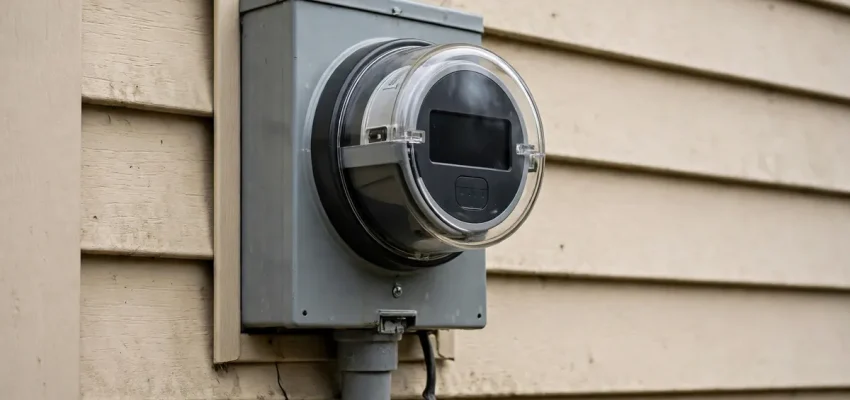
Now the most common type in the USA, with over 100 million installed. Smart meters display your reading digitally and automatically transmit usage data to your utility — usually every 15 minutes to every hour. Most have an LCD screen cycling through displays: total kWh, current demand, and sometimes time-of-use breakdowns.
Smart meters enable time-of-use billing, detailed usage portals, and faster outage detection. If you have one, your utility likely offers an online dashboard showing your consumption patterns — far more useful than manual readings for understanding your usage. Check your utility’s website to access this data.
How to Read an Analog Dial Meter
This is the trickiest meter type, so let us break it down carefully. Your meter has 4 or 5 dials in a row, each labeled with numbers 0–9. Here is how to read your electric meter dials correctly:
Step 1: Read left to right. Each dial represents one digit of your total kWh, with the leftmost dial being the highest place value.
Step 2: Note the direction. Adjacent dials rotate in opposite directions — the first goes clockwise, the second counterclockwise, and so on. The numbers are arranged accordingly, so just follow the numbering on each dial.
Step 3: Read the lower number. When the pointer is between two numbers, always record the lower number — with one exception (see next step). This is the most common mistake.
Step 4: Check the dial to the right. If the pointer is directly on a number, look at the dial immediately to its right. If that right-hand dial has passed zero, record the number the pointer is on. If it has not passed zero, record the next lower number. This accounts for the mechanical linkage between dials.
Step 5: Ignore red dials or multipliers. Some meters have a red dial or a multiplier noted on the face (e.g., “×10”). For standard residential meters, you read all black dials and apply any noted multiplier. Most residential meters have no multiplier.
Example: dials reading 4-3-7-2-8 left to right = 43,728 kWh cumulative. Your usage for a billing period is the current reading minus the previous reading.
How to Read Digital and Smart Meters
Digital meters could not be simpler: read the number on the display. That is your cumulative kilowatt-hours. For smart meters with cycling displays, wait for the screen showing “kWh” or total energy — usually the first or most prominent display.
Some smart meters show multiple values: total kWh, current kW demand, voltage, and time-of-use registers (on-peak vs. off-peak kWh). For billing verification, you want total kWh. For understanding your usage patterns, the time-of-use breakdowns are gold — they show when you use power, which matters if you are on a time-of-use rate plan.
Most utilities with smart meters offer online portals or apps showing your usage in 15-minute intervals. This is far more practical than manual readings for identifying energy hogs. Log in and explore — you might discover your EV charger or pool pump is driving unexpected costs.
Calculating Your Electricity Usage and Costs
Once you know how to read your electric meter, calculating usage is simple arithmetic:
Usage (kWh) = Current reading − Previous reading
Example: current reading 43,728 kWh, last month’s reading 42,915 kWh. Usage = 43,728 − 42,915 = 813 kWh for the billing period.
Cost = Usage × Your rate per kWh
Find your rate on your electric bill — it is listed as cents per kWh. The US average is around 16–17 cents/kWh, but rates range from under 10 cents (Louisiana, Washington) to over 40 cents (Hawaii, California). At 16 cents: 813 kWh × $0.16 = $130.08 in energy charges, plus fixed fees and taxes.
Track readings weekly for a month to identify patterns. High-usage days often correlate with specific activities: laundry day, extreme weather (HVAC working hard), or guests. This awareness is the first step toward meaningful savings.
Verifying Your Bill for Accuracy
Estimated readings are the most common billing issue. When utilities cannot access your meter (locked gates, aggressive dogs, bad weather), they estimate usage based on history. Estimates can be wildly off — especially if your usage patterns changed.
Your bill should indicate whether the reading was “actual” or “estimated.” If estimated for multiple months, read your meter and call the utility with the actual reading. They will adjust your bill. Smart meters have largely eliminated this problem, but analog-meter customers should stay vigilant.
Also verify the rate applied matches your rate plan, especially if you are on time-of-use billing. Mistakes happen — a misapplied rate can cost hundreds before anyone notices. Understanding how to read your electric meter gives you the tools to catch these errors.
Using Meter Readings to Save Money
Identify Energy Hogs
Take readings before and after running major appliances to learn their actual consumption. A single reading before and after a dryer cycle reveals its cost. Do this for your biggest loads: HVAC, water heater, dryer, pool equipment, space heaters. The results often surprise — many homeowners discover their “efficient” lifestyle has an expensive blind spot.
For continuous monitoring, consider a home energy monitor that clamps onto your panel feeders (like Sense or Emporia). These $100–$300 devices show real-time usage by circuit, making it easy to spot waste. Pair this knowledge with targeted upgrades — see whole-house surge protector installation as an example of panel-adjacent improvements worth considering.
Shift Usage to Off-Peak Hours
If your utility offers time-of-use rates, electricity costs less at night and on weekends. Shifting flexible loads — dishwasher, laundry, EV charging — to off-peak hours can cut those loads’ costs by 30 to 50 percent. Your smart meter’s time-of-use displays show exactly when you are using peak versus off-peak power.
Detect Problems Early
Sudden unexplained usage spikes indicate problems: a failing water heater element working overtime, a well pump running continuously due to a leak, a stuck HVAC auxiliary heat strip, or even electricity theft (rare but real). If your meter shows high consumption when everything seems off, investigate — turn off breakers one by one to isolate the culprit circuit.
A meter spinning rapidly with all breakers off suggests a problem between the meter and panel — call your utility immediately. This could indicate a dangerous fault or meter malfunction.
Smart Meter Concerns: Privacy and Accuracy
Some homeowners worry about smart meter data privacy or accuracy. On accuracy: smart meters are tested to ANSI standards and are generally more accurate than aging analog meters, which tend to under-register as they wear. If anything, switching to a smart meter may slightly increase your bill — not because the new meter is wrong, but because the old one was undercounting.
On privacy: smart meters collect usage data, not personal information. Utilities are subject to data protection regulations, and most allow you to opt out of smart metering (usually for a monthly fee to cover manual reading costs). The detailed usage data is also your tool — it empowers the energy-saving strategies above.
If you suspect your meter is inaccurate, every utility has a testing process. You can request a meter test (sometimes free, sometimes $25–$50, refunded if the meter is faulty). Independent testing is also available. Document your own readings before requesting a test.
Frequently Asked Questions
Where is my electric meter located?
Usually on an exterior wall near where the service drop connects to your house, often near the electrical panel (which is typically just inside). In apartments and condos, meters may be grouped in a utility room. If you cannot find it, call your utility — they will tell you.
Can I read my own meter for the utility?
Yes. Most utilities accept customer readings, especially to correct estimated bills. Some offer online or app-based self-reporting. Provide the full reading including all digits.
What does it mean if my meter is running fast with everything off?
Turn off all breakers and check again. If the meter still advances significantly, there may be a fault, unauthorized tap, or meter issue. Contact your utility promptly — and consider an electrical inspection to rule out wiring problems.
Learning how to read your electric meter is a small skill with outsized benefits: billing confidence, energy awareness, early problem detection, and the foundation for cutting your power costs. Take a reading today — future you will thank present you.
What Your Meter Readings Reveal About Home Systems
Regular meter readings do more than verify bills — they provide early warning of developing problems across your home’s systems. A gradual upward creep in baseline usage (the amount consumed with minimal activity) often points to degrading equipment: an aging refrigerator working harder, a water heater with failing insulation, or an HVAC system losing efficiency. Cross-reference suspicious patterns with our guides on troubleshooting a tripped breaker (which can indicate overloaded circuits driving excess consumption) and whole-house surge protector benefits (since power quality issues can both inflate readings and damage equipment).
If readings suggest your electrical infrastructure is struggling — frequent breaker trips accompanying high usage, or consumption that seems disproportionate to your lifestyle — consider a professional electrical inspection to evaluate panel capacity and circuit health. Homeowners planning significant additions like EV chargers or workshops should establish baseline readings first, so the new load’s impact is measurable. For targeted savings, our recessed lighting guide explains how efficient fixtures trim consumption, and generator installation costs are worth reviewing if outages — not just high bills — are your concern.