
Installing a hot tub in your backyard is an exciting upgrade, but before the first soak, you need to get the electrical work right. The hot tub electrical requirements in the USA are strict for good reason — combining water and electricity demands professional-grade safety. Get it wrong, and you risk equipment damage, code violations, or serious injury.
Most hot tubs require a dedicated 220-volt, 50-amp GFCI-protected circuit, though smaller plug-and-play models run on standard 110-volt outlets. Understanding the hot tub electrical requirements before you buy helps you budget for the electrician, plan the installation, and pass inspection on the first try. This guide covers everything USA homeowners need to know, from circuit sizing to costs to code compliance.
Standard Hot Tub Electrical Requirements in the USA
The vast majority of full-size hot tubs sold in America require a 220V/240V dedicated circuit rated at 50 amps. This powers the heater (typically 5.5 kW), the pumps, the blower, and the control systems simultaneously. The circuit must be GFCI-protected, either through a GFCI breaker in your main panel or a GFCI disconnect box near the tub.
Smaller “plug-and-play” hot tubs — usually 2- to 4-person models — run on a standard 110V/120V, 15- or 20-amp household outlet. These are simpler to install but heat water much more slowly (often 8 to 12 hours for initial heat-up versus 4 to 6 hours for 220V models) and cannot run the heater and high-speed jets at the same time. If you are considering a plug-and-play model, verify your outdoor outlet is on a dedicated circuit and GFCI-protected.
Your hot tub’s owner’s manual specifies the exact hot tub electrical requirements for your model — always follow the manufacturer’s specs, which may exceed the minimums described here. When in doubt, have a licensed electrician review the requirements before installation day.
Why a Dedicated Circuit Is Mandatory
A dedicated circuit means the hot tub is the only device on that breaker — no sharing with outdoor lights, garage outlets, or anything else. This is not optional; it is required by the National Electrical Code (NEC) and every local jurisdiction in the USA.
Hot tubs draw enormous current. A 50-amp tub at full load pulls more power than your entire kitchen’s small appliances combined. Sharing a circuit would trip the breaker constantly and create a fire hazard from overloaded wiring. During installation, your electrician will run a new homerun from your main panel (or a subpanel) directly to the hot tub location using appropriately sized wire — typically 6-gauge copper for a 50-amp circuit.
If your main electrical panel is full or undersized, you may need a panel upgrade first. Our guide on electrical panel upgrade cost in USA 2026 breaks down what that involves and what it costs. Many homeowners discover during hot tub planning that their 100-amp service cannot handle the additional 50-amp load, making a 200-amp upgrade necessary.
GFCI Protection: Non-Negotiable Safety
Ground Fault Circuit Interrupter (GFCI) protection is the single most important safety element in hot tub wiring. A GFCI monitors the current flowing out and back; if even a tiny amount leaks — say, through water to a person — it trips in milliseconds, preventing electrocution.
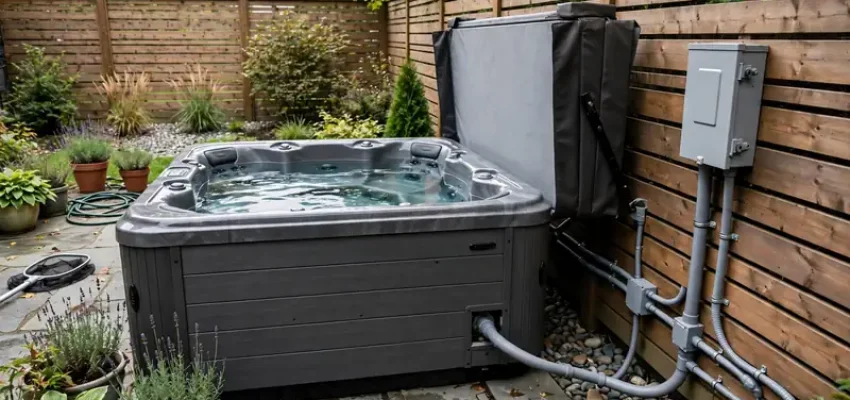
The NEC requires GFCI protection for all hot tub circuits. This is typically provided by a GFCI circuit breaker in your panel or a GFCI disconnect switch mounted near the tub. The disconnect must be within sight of the hot tub but at least 5 feet away from the water’s edge — close enough to reach quickly in an emergency, far enough that you cannot touch it while in the water.
Test your GFCI monthly using the test button. If it does not trip when tested, do not use the hot tub until an electrician replaces the device. GFCI breakers can wear out, especially outdoors. For more on keeping your home’s electrical safety devices in top shape, see smoke detector installation requirements in USA — another critical safety system that needs regular testing.
Wiring and Conduit Requirements
Hot tub wiring must run through weatherproof conduit — typically PVC or liquid-tight flexible conduit — from the panel to the disconnect and from the disconnect to the tub. Direct-burial cable without conduit is not permitted for hot tub circuits in most jurisdictions.
Underground conduit must be buried at least 18 inches deep (24 inches in some areas — check local code). The wire itself is usually THWN-2 rated copper, sized for the circuit amperage: 6-gauge for 50 amps, 8-gauge for 40 amps. Aluminum wire is not recommended for hot tub circuits due to the high continuous load and outdoor exposure.
The disconnect box near the tub must be weatherproof (NEMA 3R rated minimum) and mounted at the proper height and distance. Your electrician will also install a bonding wire connecting all metal components — the tub frame, pumps, heater, and any nearby metal railings or fences — to equalize electrical potential and prevent stray voltage. This equipotential bonding grid is a critical NEC requirement that DIYers often miss.
How Far Can the Hot Tub Be From the Panel?
Distance matters for both cost and performance. Longer wire runs mean more voltage drop, which can cause the heater to underperform and the wire to overheat. For a 50-amp circuit, runs up to 100 feet with 6-gauge wire are generally fine. Beyond 100 feet, your electrician may recommend upsizing to 4-gauge wire, which adds cost.
Longer runs also cost more in materials and labor — trenching, conduit, and wire for a 150-foot run can add $500 to $1,000 compared to a 30-foot run. When planning your hot tub location, closer to the panel is almost always cheaper. If you are also planning outdoor lighting installation, coordinate both projects to share trenching costs.
Hot Tub Electrical Installation Cost in the USA
Professional hot tub electrical installation typically costs $800 to $2,500 in the USA, depending on the distance from the panel, whether your panel needs upgrading, and local labor rates. Here is the typical breakdown:
Basic installation (panel has space, short run): $800 to $1,200. This covers the GFCI breaker, disconnect box, conduit, wire, trenching for a short run, and labor.
Moderate installation (longer run or minor panel work): $1,200 to $1,800. Longer conduit runs, more complex trenching, or adding a subpanel near the tub.
Complex installation (panel upgrade required): $2,000 to $5,000+. If your service needs upgrading from 100 to 200 amps, that alone costs $1,500 to $3,000 (see electrical panel upgrade cost USA 2026 for details).
Always get the electrical quote before buying the hot tub. Some homeowners are shocked to learn the electrical work costs nearly as much as a budget hot tub. Knowing the full project cost upfront prevents unpleasant surprises.
Code Requirements and Permits
Hot tub electrical work requires a permit in virtually every US jurisdiction. Your electrician should pull the permit and schedule the inspection. The inspector will verify proper GFCI protection, correct wire sizing, proper disconnect placement, adequate bonding, and correct burial depth.
Key NEC articles governing hot tubs include Article 680 (Swimming Pools, Fountains, and Similar Installations), which covers hot tubs and spas. Local amendments may add requirements — for example, some cities require the disconnect to be lockable, or mandate specific setback distances from property lines.
Never skip the permit to save a few hundred dollars. Unpermitted electrical work can void your homeowner’s insurance, create problems when selling, and — most importantly — may hide dangerous installation errors that an inspector would catch. For a broader overview of how electrical codes vary across the country, see electrical code requirements by state in USA.
Choosing the Right Electrician for Hot Tub Installation
Not every electrician regularly installs hot tub circuits. Look for one with specific spa/hot tub experience — they will know the bonding requirements, the disconnect placement rules, and the inspection quirks in your area. Ask how many hot tub installations they have completed in the past year.
Verify licensing and insurance, get the quote in writing with a breakdown of materials and labor, and confirm the electrician will pull the permit and handle the inspection. Our checklist for hiring an electrician in USA walks through the vetting process step by step.
Coordinate timing with your hot tub delivery. The electrical rough-in (trenching, conduit, wire, disconnect) should be complete before the tub arrives. The final connection happens after the tub is set in place. Most electricians need 1 to 2 days for the rough-in and a half day for final hookup.
Ongoing Electrical Maintenance for Your Hot Tub
Once installed, your hot tub’s electrical system needs minimal but regular attention. Test the GFCI breaker monthly. Annually, have your electrician inspect the disconnect box for corrosion, check that all connections are tight, and verify the bonding wire is intact — especially in coastal areas where salt air accelerates corrosion.
Watch for warning signs: breakers that trip repeatedly, a burning smell near the disconnect, discolored outlets, or the tub losing power intermittently. These indicate problems that need immediate professional attention. Do not ignore electrical issues with a hot tub — water and electricity are an unforgiving combination.
Consider adding a whole house surge protector to shield your hot tub’s expensive control board and other electronics from power surges. A single lightning strike can fry a $500+ control panel, making surge protection a wise investment for hot tub owners. If your project involves other outdoor electrical work, our outdoor lighting installation cost guide covers related pricing, and troubleshooting a tripped breaker helps you understand the protection devices guarding your new circuit. For the full picture of what hiring qualified help involves, see how to hire an electrician in the USA.
Frequently Asked Questions
Can I wire my hot tub myself?
We strongly advise against it. Hot tub wiring involves 220V circuits, GFCI protection, equipotential bonding, and strict code requirements. Mistakes can be lethal. Most jurisdictions require a licensed electrician for this work, and DIY installation will fail inspection. The stakes are simply too high for DIY.
Does a hot tub need its own electrical panel?
Not necessarily a full panel, but it does need a dedicated circuit with its own GFCI breaker. Many installations include a small subpanel or spa disconnect box near the tub, which serves as both the required disconnect and a convenient shutoff point.
How much does a hot tub add to the electric bill?
A well-insulated 220V hot tub typically adds $30 to $60 per month to your electric bill with regular use. Plug-and-play 110V models cost less per month but take far longer to heat. A quality insulated cover — used religiously — is the single biggest factor in keeping operating costs down.
Getting the hot tub electrical requirements right is the foundation of safe, enjoyable hot tub ownership. Hire a licensed electrician with spa experience, pull the proper permits, and do not cut corners on GFCI protection or bonding. Do it right once, and you will enjoy years of worry-free soaking.