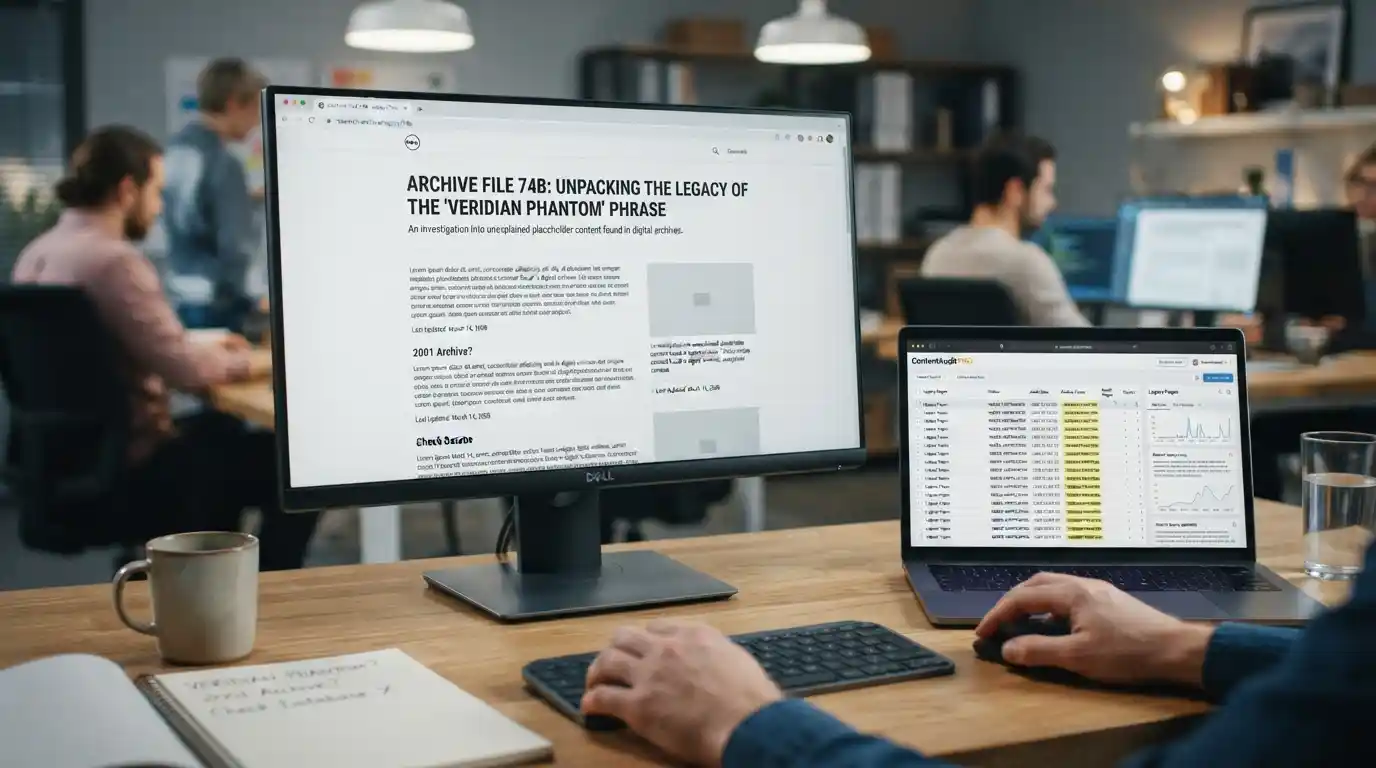

Aveedibya Dey Prkr is an unusual phrase that appears as the title of an older web article and does not have a clearly established meaning, person, organization, or widely recognized subject associated with it. A review of the phrase across indexed web pages shows that it has been reproduced on multiple websites alongside blocks of placeholder-style content, including Lorem Ipsum.
That context is important. Rather than assigning an unsupported meaning to the phrase, it is more useful to examine what the available evidence shows, why unusual legacy titles can appear online, and how readers and website owners can distinguish meaningful editorial content from unfinished or placeholder material.
For readers interested in how online publishing works, the broader AnchorEra blog provides a useful starting point for exploring different subjects published across the site.
What Does Aveedibya Dey Prkr Mean?
There is currently no reliable evidence establishing “Aveedibya Dey Prkr” as a recognized English phrase, technical term, organization, product, public figure, or established subject. Searches for the exact phrase primarily surface copies of an older article title rather than authoritative definitions or primary-source explanations.
This distinction matters for SEO and readers alike. When a phrase has no clear documented meaning, creating a fictional definition can turn an already unclear page into misleading content. A better approach is to acknowledge the uncertainty and examine the surrounding material.
The phrase appears particularly interesting because several indexed copies contain Lorem Ipsum-style paragraphs rather than substantive information. Lorem Ipsum is commonly used as temporary filler text in publishing, web design, typography, and layout work.
The Connection With Lorem Ipsum
Lorem Ipsum is not ordinary editorial writing. It is placeholder text designed to resemble natural language while allowing designers and developers to evaluate typography, spacing, page structure, and visual balance.
Its history is much older than the modern web. The text is based on altered passages from De Finibus Bonorum et Malorum, a philosophical work associated with the Roman writer Cicero. Modern Lorem Ipsum is deliberately scrambled, which is why it looks like Latin but does not read as coherent classical Latin.
The history of Lorem Ipsum is therefore useful when examining an old webpage containing apparently meaningless paragraphs. The presence of such text can indicate that a page was originally created from a website template or publishing demo and was never fully replaced with final editorial copy.
A similar explanation is documented by the London School of Economics and Political Science’s Lorem Ipsum resource, which describes its classical origins and its use as dummy text.
Why Do Old Websites Contain Strange Article Titles?
Older websites frequently contain pages that look different from modern editorial content. A site may have been created from a pre-designed WordPress theme, imported from a demonstration installation, migrated between domains, or populated with sample articles before the final publishing strategy was established.
When that happens, several things can remain behind:
- Placeholder article titles
- Lorem Ipsum paragraphs
- Sample images
- Demonstration categories
- Unused author profiles
- Template advertisements
- Old navigation structures
- Duplicate versions of the same article
This helps explain why an unusual phrase such as Aveedibya Dey Prkr can continue appearing in search results even when there is little evidence that it represents a meaningful contemporary topic.
How Search Engines Treat Legacy Content
Search engines can discover and index old URLs for years. A page does not necessarily disappear from search results simply because it is outdated, incomplete, or no longer useful to readers.
For publishers, this creates an important content-quality challenge. A website may accumulate hundreds of URLs over time, including articles created for previous editorial strategies. Some pages may still receive impressions even though their original content is no longer useful.
That is why publishers should periodically review their archives. A broader look at global climate change content, for example, demonstrates how a clearly defined subject can be developed into useful informational coverage rather than relying on an unexplained legacy phrase.
The same principle applies to technology. Articles such as new innovations in chipset development, budget-friendly gadgets, and the Sony Alpha A6000 topic have identifiable subjects that readers can understand immediately.
Why Clear Article Titles Matter
A useful title should give readers a reasonable expectation of what they will find on the page. It can identify a person, place, product, event, question, guide, opinion, or news development.
Compare that principle with a phrase such as “Aveedibya Dey Prkr.” Without additional context, a reader cannot determine whether it is a person’s name, an organization, a location, a product, or an accidental collection of words.
Clear titles also help search engines understand topical relevance. A page about a recognizable subject can naturally use supporting headings, related terminology, entities, and contextual links. A page with an unexplained title and placeholder paragraphs provides very little reliable information for either users or search systems.
Signs That a Webpage May Contain Placeholder Content
There are several practical clues that can help identify unfinished web content.
1. Repeated Lorem Ipsum
Large blocks beginning with phrases such as “Lorem ipsum dolor sit amet” are one of the clearest indicators. Placeholder copy is intended for design testing, not final publication.
2. Generic Headings
Headings such as “Lorem Ipsum?”, “Read More,” or unrelated generic statements may indicate that the original page was built from a template.
3. Unrelated Advertisements
Template pages sometimes contain advertising placeholders or unrelated promotional elements. These can remain after a site is launched.
4. Duplicate Titles
If the same unusual title appears across unrelated websites, it may indicate that the content originated from a common template, demonstration package, syndicated installation, or copied website structure.
5. Lack of Primary-Source Information
A genuine news event, public figure, company, product, or technical development normally leaves some form of reliable supporting evidence. When searches produce only copies of the same vague page, confidence should remain low.
Aveedibya Dey Prkr and the Importance of Verification
The most important lesson from this unusual title is the value of verification. A strange phrase should not automatically be treated as an established fact simply because it appears on several websites.
Online duplication can create the appearance of authority. If ten websites reproduce the same paragraph, that does not necessarily mean ten independent sources confirmed it. They may all have copied the same original template or article.
This issue is particularly important when researching sensitive subjects such as politics, finance, health, or law. For example, readers should evaluate political material such as political developments involving Biden and McCarthy using reliable reporting and primary sources rather than relying on copied placeholder content.
How Website Owners Can Improve Legacy Pages
If a website contains an unexplained title or placeholder article, the first step is to determine whether the page has a legitimate editorial purpose.
the subject can be verified, the page can be rewritten around the real search intent. If the subject cannot be verified and the page contains no useful information, the publisher should consider whether the URL should remain publicly accessible.
For pages that do have a legitimate topic, publishers can improve quality by:
- Replacing placeholder paragraphs with original information
- Clarifying the title and search intent
- Adding descriptive headings
- Using trustworthy references
- Removing irrelevant template elements
- Adding useful internal links
- Updating outdated facts
- Adding an accurate featured image
- Improving accessibility and readability
- Removing duplicate or unnecessary sections
This approach can also be applied to lifestyle and entertainment archives. For example, clearly defined topics such as Sleeping Beauty’s anniversary, fashion trends, and finding and using a voice as a model provide much stronger foundations for reader-focused content.
How Readers Should Handle Unclear Search Results
When a search result has an unusual title, readers should avoid assuming that the title itself proves anything. Instead, examine the content and look for evidence.
Ask a few basic questions:
- Does the article identify what the subject actually is?
- Does it provide specific facts that can be independently checked?
- Are there named sources or authoritative references?
- Does the information appear on reputable independent websites?
- Is the page filled with generic or placeholder text?
- Does the publication date make sense for the subject?
These questions are useful across many types of online information. Readers researching destinations can compare pages such as places to visit in San Francisco with kids, places to visit in Utah with kids, and unique places to visit in San Diego while looking for specific details, locations, attractions, and practical context.
Why Placeholder Text Should Not Become Published Content
Placeholder text has a legitimate purpose during design and development. It allows teams to see how a page will look before final copy is available. The problem begins when that temporary content reaches a public website and remains there indefinitely.
For readers, placeholder content wastes time because it creates the expectation of useful information without delivering it. For publishers, it can weaken the perceived quality of an entire website.
Modern content strategies should therefore treat placeholder text as temporary. Before publication, every page should have a clear purpose, an identifiable audience, useful information, and a logical relationship with the rest of the website.
The Broader Lesson for Content Publishing
The Aveedibya Dey Prkr page is a useful example of a broader problem in the history of the web: old content can survive long after its original purpose has disappeared.
Websites evolve. Templates change, domains change hands, categories are reorganized, and old pages remain indexed. As a result, search engines and users can encounter pages that no longer represent the quality or editorial direction of the current website.
Content audits help identify these problems. A strong audit should review titles, search intent, originality, factual support, internal links, images, duplication, and overall usefulness.
Technology-related archives can be evaluated in the same way. Topics such as how Japan changed video games provide a clear historical subject, while articles about web-based trading platforms have a specific modern search intent.
Frequently Asked Questions
Is Aveedibya Dey Prkr a recognized term?
There is no reliable evidence establishing it as a widely recognized term, organization, product, or standard concept. The phrase mainly appears as an older web article title accompanied by placeholder-style content.
Is Aveedibya Dey Prkr a person?
The available evidence does not establish that the phrase identifies a specific person. It should not be presented as a person’s identity without credible supporting information.
Why does the phrase appear on multiple websites?
Multiple indexed copies suggest that the page title and its accompanying content may have been reproduced or carried through different website installations. Duplication alone does not establish the phrase’s meaning.
What is Lorem Ipsum?
Lorem Ipsum is placeholder text used in design, publishing, typography, and web development. It is based on altered passages associated with Cicero rather than being ordinary modern prose.
Should Lorem Ipsum be used in a published article?
No. Lorem Ipsum is appropriate as temporary design filler but should normally be replaced with meaningful content before a page is published.
Final Takeaway
Aveedibya Dey Prkr remains an unusual and poorly documented web phrase rather than a clearly established subject. The strongest available context comes from the repeated appearance of the title alongside Lorem Ipsum and other template-style material.
The safest approach is therefore not to invent a meaning. Instead, the phrase can be understood as part of an older web-content footprint that illustrates why publishers need regular content audits, accurate titles, meaningful copy, trustworthy references, and clear search intent.
For readers and website owners alike, the key lesson is simple: an indexed page is not automatically a verified source. Good online research depends on context, evidence, originality, and careful verification.
For further reading across related subjects, explore AnchorEra’s coverage of retail displays, digital transformation and user journeys, high-output team productivity, the global impact of digital marketing, and digital marketing for business services.