
You have picked the perfect flooring, hired the installer, and scheduled the project — then the installer takes one look at your subfloor and delivers bad news: it is not level. Understanding floor leveling cost before installation helps USA homeowners budget for this common hidden expense and avoid project delays. Uneven subfloors are one of the most frequent surprises in flooring projects, especially in older homes.
Floor leveling — also called floor flattening or subfloor preparation — ensures your new flooring sits on a flat, stable surface. Skipping it leads to cracked tile, gapped hardwood, bouncy laminate, and voided warranties. This guide covers the floor leveling cost before installation in USA homes, the methods contractors use, when leveling is required, and how to tell if your floors need it.
Average Floor Leveling Cost Before Installation USA
The floor leveling cost before installation in USA homes typically ranges from $2 to $8 per square foot, depending on the method and severity. For a 500-square-foot area, expect $1,000 to $4,000. Minor leveling with self-leveling compound on a small area might cost just $300 to $600, while major structural corrections involving sistering joists can exceed $5,000.
Most flooring manufacturers specify flatness tolerances: generally 3/16 inch of variation over 10 feet for hardwood and laminate, and 1/4 inch over 10 feet for tile. If your subfloor exceeds these tolerances, leveling is not optional — it is required for warranty coverage. Installers will check with a long straightedge or laser level during the estimate. Get this assessment before committing to a flooring purchase. For context on the flooring itself, see our hardwood floor installation cost USA 2026 and tile installation cost in USA guides.
Floor Leveling Methods and Costs
Self-Leveling Compound: $2–$5 Per Square Foot
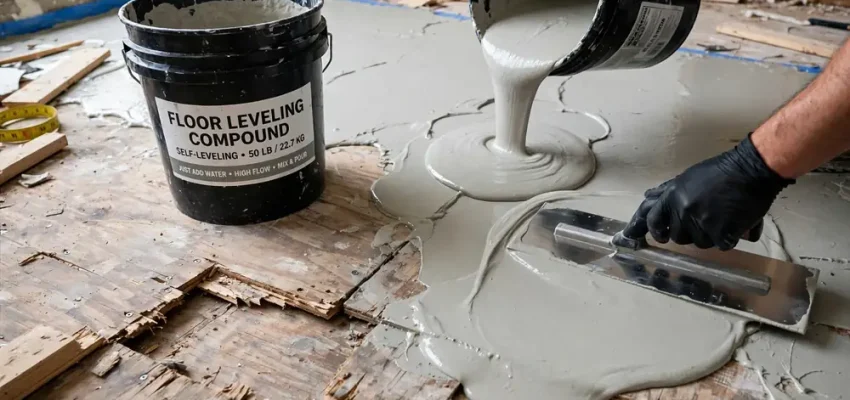
Self-leveling underlayment (SLU) is a cement-based compound poured onto the subfloor that flows flat and hardens into a smooth surface. It is the most common leveling method for concrete slabs and plywood subfloors with dips up to 1 inch. A 50-pound bag covers about 50 square feet at 1/8-inch thickness and costs $30 to $50. Professional application runs $2 to $5 per square foot including materials.
SLU works best for broad, shallow unevenness — the wavy floors common in older homes. It is not suitable for structural problems like sagging joists. Application is fast (a crew can pour 1,000 square feet in a day), but the compound needs 24 hours to cure before flooring installation. This adds a day to your project timeline.
Floor Patching: $1–$3 Per Square Foot
For small low spots, cracks, and holes, cement-based floor patch fills the gaps without pouring an entire leveler coat. Contractors trowel patch into depressions and feather the edges smooth. This is the cheapest option when unevenness is localized — a few dips rather than a wavy entire floor. Expect $200 to $600 for patching a typical room.
Plywood Underlayment: $3–$6 Per Square Foot
Adding a layer of plywood over the existing subfloor creates a fresh, flat surface. Contractors screw down 1/4-inch to 1/2-inch plywood, shimming low spots as needed. This method also strengthens bouncy floors. Materials cost $1 to $2 per square foot; labor adds $2 to $4. Plywood underlayment is standard prep for tile installations over wood subfloors. If you are removing old flooring first, our how to remove old tile flooring USA guide covers the demolition phase.
Sistering Floor Joists: $100–$300 Per Joist
When floors sag due to undersized, damaged, or rotted joists, the structural fix is sistering — attaching new joists alongside old ones to stiffen and level the structure. This is carpentry work, not just floor prep, and costs $100 to $300 per joist. A sagging 15-foot span might need 8 to 10 sistered joists: $800 to $3,000. This addresses the cause, not just the symptom.
Mudjacking/Slab Jacking: $500–$1,500 Per Area
For sunken concrete slabs (common in garages, basements, and additions), mudjacking pumps a cement slurry under the slab to lift it level. Polyurethane foam injection (polyjacking) is a modern alternative — lighter, more precise, and longer-lasting at $1,000 to $2,500 per area. Either method avoids the $4,000 to $8,000 cost of tearing out and repouring the slab. For basement-specific flooring guidance, see best flooring for basements USA.
Signs Your Floor Needs Leveling
Visible slopes or dips. Place a marble on the floor — if it rolls consistently in one direction, you have a slope. Lay a 6-foot level or straightedge across the floor; gaps underneath reveal low spots.
Bouncy or spongy feel. Floors that flex underfoot indicate inadequate subfloor thickness or joist spacing issues. Bouncy floors must be stiffened before any hard flooring goes down.
Cracked tile or grout. If your existing tile floor has cracked tiles or crumbling grout lines, subfloor movement or unevenness is the likely cause. New tile over the same unlevel surface will crack again.
Gaps in hardwood or laminate. Separating boards, especially in the middle of the floor (not just seasonal edge gaps), suggest subfloor unevenness pushing boards apart.
Doors that stick or swing. When floors heave or settle unevenly, door clearances change. A door that suddenly scrapes the floor may signal subfloor movement needing correction before new flooring.
Floor Leveling Cost by Flooring Type
Different flooring materials have different flatness requirements, which affects the floor leveling cost before installation:
Tile: Least forgiving. Requires the flattest surface (1/4 inch per 10 feet max, 1/8 inch preferred for large-format tile). Tile over uneven floors cracks — period. Budget $3 to $8 per square foot for thorough prep.
Hardwood: Moderately forgiving. Solid hardwood needs 3/16 inch per 10 feet. Engineered hardwood tolerates slightly more. Expect $2 to $6 per square foot for leveling.
Laminate and vinyl plank: Most forgiving of the hard surfaces. Quality LVP tolerates up to 3/16 inch per 10 feet, and its flexibility hides minor imperfections. Often $1 to $4 per square foot suffices. See vinyl plank flooring pros and cons USA for LVP specifics.
Carpet: Most forgiving overall. Carpet and thick padding hide significant unevenness. Minor leveling ($1 to $3 per square foot) is usually enough. Our carpet installation cost USA 2026 guide covers the full project.
How to Save on Floor Leveling Costs
Get the assessment during the flooring estimate. Reputable flooring contractors check subfloor flatness as part of their quote. If one contractor flags leveling needs and another does not, the second may be planning to install over problems — or planning a surprise change order mid-project. The thorough estimator is doing you a favor.
Address the cause, not just the symptom. Pouring leveler over a structurally sagging floor wastes money — the sag continues and cracks the leveler. If joists are the problem, sister them first. It costs more upfront but prevents repeat expenses.
Bundle leveling with installation. Hiring the same contractor for leveling and flooring installation is almost always cheaper than hiring separately. They can schedule efficiently and warranty the whole job. Ask for a single all-in quote.
Consider whether replacement beats repair. In severely damaged subfloors (extensive rot, major settlement), tearing out and replacing the subfloor ($4 to $8 per square foot) may cost the same as heroic leveling efforts — with a better result. Get quotes for both approaches.
DIY Floor Leveling: Is It Feasible?
Minor leveling with self-leveling compound is DIY-possible for handy homeowners. A 50-pound bag costs $30 to $50, and the process — prime the subfloor, mix the compound, pour, and let it flow — is straightforward for small areas. However, SLU sets fast (20 to 30 minutes working time), so mistakes are permanent. Start with a closet or small room, not your living room.
Structural corrections (sistering joists, mudjacking) are not DIY projects. Neither is large-area SLU pouring, which requires experience to avoid high spots that are harder to fix than the original low spots. The floor leveling cost before installation for professional work buys expertise that prevents expensive do-overs.
If your project involves a full remodel, coordinate leveling with other trades. Our kitchen remodel cost in USA 2026 and bathroom remodel cost in USA 2026 guides help you sequence subfloor work within larger renovations.
Frequently Asked Questions
How do I know if my floor is level enough?
Lay a 10-foot straightedge (or laser level) on the bare subfloor. Measure gaps underneath. Under 3/16 inch for hardwood/laminate or 1/4 inch for tile is generally acceptable. More than that needs correction.
Can I install flooring over an unlevel floor?
You can, but you should not. Uneven floors cause cracked tile, gapped wood, premature wear, and voided manufacturer warranties. The repair cost later far exceeds the leveling cost now.
How long does floor leveling take?
Self-leveling compound: 1 day to pour plus 24 hours cure time. Plywood underlayment: 1 to 2 days. Sistering joists: 2 to 4 days. Plan leveling into your project timeline — it is not instantaneous.
Understanding floor leveling cost before installation helps you budget realistically and avoid mid-project surprises. Get the subfloor assessed during your flooring estimate, address structural causes properly, and never skip leveling to save money — your new floors will thank you for decades. For pet households planning new floors, our how to choose flooring for pets USA guide pairs well with subfloor prep planning, and tile vs laminate in bathrooms USA covers material choices for wet areas once your subfloor is flat.