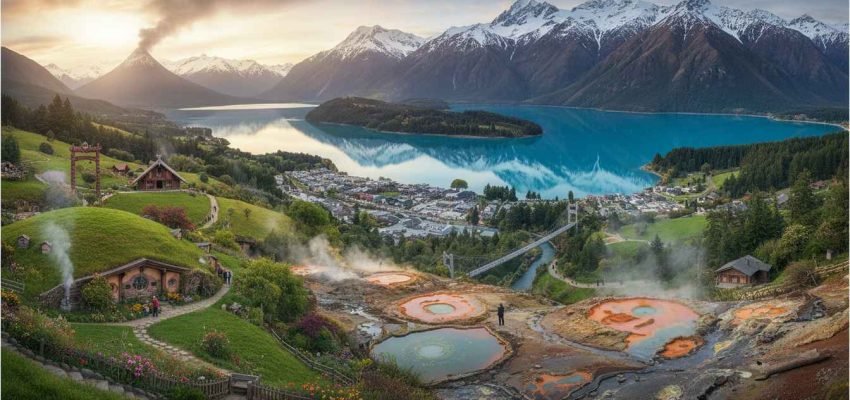
New Zealand landscape with green hills, mountains, and a hobbit-style dwelling

Lord of the Rings Places to Visit in New Zealand: 20 Must-See Filming Locations

New Zealand is one of the world’s most memorable destinations for The Lord of the Rings fans. Peter Jackson’s film trilogy used more than 150 locations across the country’s North and South Islands, turning mountains, forests, rivers, valleys, farmland, and national parks into the landscapes of Middle-earth. Many of these places can still be visited today, although some are remote conservation areas rather than conventional tourist attractions.

From the rolling green hills of Hobbiton to the dramatic mountains around Queenstown and the rugged landscapes of Canterbury, a Lord of the Rings places to visit in New Zealand itinerary can combine movie history with some of the country’s best natural scenery.

This guide highlights the most worthwhile filming locations, explains what each location represented in the movies, and offers practical considerations for planning a Middle-earth-inspired New Zealand trip.

Why Visit Lord of the Rings Filming Locations in New Zealand?

The appeal goes beyond seeing a recognizable movie backdrop. New Zealand’s landscapes were central to the visual identity of Middle-earth. The country’s geography allowed the production to move between peaceful farmland, dense native forest, alpine mountains, volcanic terrain, rivers, and remote wilderness.

Some locations are easy to visit independently, while others require a long hike, specialist tour, or access through conservation land. That makes it important to distinguish between locations that are designed for visitors and locations that are primarily scenic viewpoints or wilderness areas.

For travelers building a broader itinerary, New Zealand’s South Island is particularly useful because several movie-related locations can be combined with other scenic destinations. You can also explore our guide to the top places to visit in New Zealand’s South Island for additional ideas.

1. Hobbiton Movie Set, Matamata

Hobbiton is arguably the most recognizable Lord of the Rings filming location in New Zealand. Located near Matamata in the Waikato region, the site was transformed into the Shire, home of Bilbo and Frodo Baggins.

Unlike many filming locations that simply look similar to their movie appearances, Hobbiton remains a purpose-built attraction. Visitors can walk among the hobbit holes, see the Green Dragon Inn, cross the village area, and experience the carefully maintained landscape that helped create the Shire.

For first-time visitors, Hobbiton is one of the easiest places to include in a Middle-earth itinerary because it provides a structured visitor experience rather than requiring visitors to locate an isolated filming site.

2. Mount Victoria, Wellington

Mount Victoria is one of the most accessible Lord of the Rings filming locations in Wellington. The wooded slopes were used for scenes involving the Hobbits shortly after leaving the Shire, including moments when they attempted to hide from the Black Riders.

The location is particularly convenient for travelers staying in central Wellington because it is close to the city. Visitors can combine a movie-location walk with Wellington’s wider attractions and film culture.

Wellington’s importance to the films extends beyond outdoor locations. The city became a major center for production, effects, props, miniatures, and post-production work associated with the trilogy.

3. Kaitoke Regional Park, Rivendell

Kaitoke Regional Park, north of Wellington, was transformed into Rivendell. The area’s native forest, streams, and lush surroundings provided the peaceful environment associated with the Elven refuge.

The park is a strong choice for travelers who want to experience the natural setting without attempting a difficult expedition. It also demonstrates why New Zealand’s forests worked so effectively as Middle-earth scenery.

If you are spending several days in Wellington, this location fits naturally into a wider exploration of the region’s outdoor attractions.

4. Putangirua Pinnacles, Paths of the Dead

The Putangirua Pinnacles in the Wellington region provided the dramatic landscape associated with the Paths of the Dead. Aragorn, Legolas, and Gimli traveled through this striking terrain while seeking the Army of the Dead.

The pinnacles are a genuine geological attraction rather than a purpose-built film set. The landscape’s tall, eroded rock formations create an atmosphere that feels remarkably close to the darker side of Middle-earth.

Because reaching the area involves walking, visitors should check current track conditions and allow enough time for the excursion.

5. Mount Sunday, Edoras

Mount Sunday in Canterbury is one of the most dramatic Lord of the Rings locations in New Zealand. It represented Edoras, the capital of Rohan and the home of King Théoden.

The original set was removed after filming, so visitors should not expect to find the complete city standing on the mountain. Instead, the attraction is the landscape itself: a distinctive isolated hill surrounded by broad Canterbury scenery.

The Department of Conservation identifies Mount Sunday as the filming location for Edoras, making it an especially interesting stop for fans who want to see where the Rohan landscape was created.

6. Tongariro National Park and the Mordor Landscapes

Tongariro National Park provided some of the most recognizable volcanic landscapes associated with Mordor. Mount Ngauruhoe was famously used as the visual basis for Mount Doom, while other areas of the national park represented locations throughout the journey.

Several filming sites in the wider Tongariro and Ruapehu area are accessible only from particular roads or walking routes. The scenery itself is worth visiting even if you are not attempting to recreate individual movie scenes.

Travelers should treat this as an active alpine and volcanic environment rather than a movie theme park. Weather can change rapidly, and walking conditions should be checked before setting out.

7. Tawhai Falls, The Forbidden Pool

Tawhai Falls near Whakapapa was used as the Forbidden Pool in The Two Towers. The waterfall is within Tongariro National Park and can be reached via a relatively short walking route.

This is one of the more accessible locations for travelers already exploring the Ruapehu area. The combination of waterfall scenery and cinematic history makes it a worthwhile addition to a North Island road trip.

8. Mangawhero River, Ithilien and Mordor

The Mangawhero River area near Ohakune contributed to several Middle-earth scenes. The landscape represented parts of Ithilien and Mordor, giving the production a rugged natural setting without requiring elaborate construction.

The area is particularly interesting for visitors who want to see lesser-known filming locations rather than focusing only on famous attractions.

9. Waiau River, River Anduin

On the South Island, the Waiau River between Te Anau and Manapouri represented the River Anduin. Its wide waterway and surrounding mountains gave the filmmakers a natural setting for the Fellowship’s journey.

This location works especially well as part of a Fiordland itinerary. The area offers far more than its connection to the movies, with lakes, mountains, forests, walking tracks, and access to some of New Zealand’s most spectacular wilderness.

10. Te Anau and Fangorn Forest Areas

The Te Anau area also provided landscapes used for Fangorn Forest. The surrounding forests and remote roads helped create the mysterious atmosphere associated with the ancient woodland.

Visitors should remember that not every filming point is marked like a conventional attraction. Some areas are best appreciated as part of the wider Fiordland landscape rather than as individual movie stops.

11. Glenorchy and Paradise

Glenorchy, at the northern end of Lake Wakatipu, is one of the best bases for exploring Middle-earth scenery around Queenstown. The surrounding landscapes were used for several locations, including areas associated with Lothlórien and Isengard.

The road toward Paradise is particularly scenic, with mountains, beech forests, rivers, and open valleys creating the kind of dramatic environment that made the Southern Lakes region so valuable to the production.

Glenorchy is also a worthwhile destination even for travelers who are not following a film itinerary.

12. Mount Earnslaw and Earnslaw Burn

Earnslaw Burn near Glenorchy was used for scenery in The Hobbit films and is part of the wider Middle-earth landscape around Queenstown.

The area is known for its dramatic alpine setting and waterfalls. Reaching the burn involves a challenging hike, so it is not an appropriate choice for travelers looking for a quick roadside photo.

Anyone planning the hike should prepare for changing weather, uneven terrain, and a demanding day outdoors.

13. Arrowtown and the Ford of Bruinen

Near Queenstown, Arrowtown provided access to a filming area associated with the Ford of Bruinen. The surrounding Arrow River landscape helped create the setting for one of the Fellowship’s memorable encounters.

Arrowtown itself is a popular historic destination, which makes this one of the easier places to combine film tourism with conventional sightseeing.

14. Mount Aspiring National Park

Mount Aspiring National Park contributed several dramatic landscapes to the Lord of the Rings films. The combination of rugged peaks, valleys, rivers, and native forest helped represent different areas of Middle-earth.

The park is better suited to travelers who are comfortable with outdoor activities and multi-day adventures. It should not be approached simply as a checklist of filming points because the wider landscape is the main attraction.

15. Nelson Lakes National Park

Nelson Lakes National Park in the Nelson Tasman region was used for scenes connected with Chetwood Forest and Dimrill Dale. The park’s alpine lakes and mountain scenery provide a distinctly different Middle-earth experience from the volcanic landscapes of the North Island.

Visitors interested in combining film history with hiking, lakes, and mountain scenery can make Nelson Lakes part of a broader South Island road trip.

16. Mount Owen

Mount Owen in Kahurangi National Park was used as Dimrill Dale in the films. The landscape is remote and rugged, making it very different from accessible attractions such as Hobbiton.

This is better considered a destination for experienced outdoor travelers rather than a casual filming-location stop. Route planning and local conditions matter considerably in this part of New Zealand.

17. Mount Olympus and Boulder Lake

Mount Olympus and the Boulder Lake area in Kahurangi National Park were used for scenes involving the Fellowship hiding from Saruman’s black crows.

The remote nature of the location is part of its appeal. However, visitors should not assume that every filming point is easily accessible. Some areas listed by New Zealand’s Department of Conservation involve challenging or unmarked routes.

18. Franz Josef Glacier and Mount Gunn

Mount Gunn near Franz Josef Glacier contributed to the dramatic mountain scenery associated with the White Mountains and the beacons of Gondor.

The location can be appreciated from the wider Franz Josef area, where travelers can also experience one of the West Coast’s most famous glacier landscapes.

This makes it a useful stop for visitors creating a broader South Island itinerary rather than traveling exclusively for individual film locations.

19. Lake Pukaki and the Canterbury Landscapes

Lake Pukaki and the surrounding Canterbury region are closely associated with the wider visual world of Middle-earth and were also used extensively in The Hobbit films.

The intense blue color of Lake Pukaki, mountain views, and open landscapes make this region one of the most visually impressive parts of a South Island journey.

Travelers can combine the area with other attractions around Aoraki/Mount Cook and the Mackenzie Basin.

20. Wētā Workshop and the Wellington Film Experience

Although Wētā Workshop is not itself a wilderness filming location, it is an important part of the New Zealand movie experience. Based in Wellington’s Miramar area, Wētā Workshop offers visitors a chance to learn about the practical effects, props, costumes, miniatures, and creative work behind major productions.

For a Lord of the Rings fan, combining outdoor filming locations with the Wellington film-production experience provides a more complete understanding of how Middle-earth was brought to the screen.

How to Plan a Lord of the Rings New Zealand Trip

A successful Middle-earth trip is easier when you divide the country into regions instead of trying to visit every filming location in one continuous route.

North Island Route

Start around Matamata for Hobbiton, then continue toward the Tongariro and Ruapehu region before heading to Wellington. This route combines the Shire, Mordor landscapes, waterfalls, forests, and Wellington’s film-production heritage.

South Island Route

For the South Island, Queenstown and Glenorchy make excellent bases for exploring Southern Lakes locations. From there, travelers can continue toward Fiordland, Canterbury, Nelson Tasman, or the West Coast depending on the length of the trip.

If you want more general destination inspiration, our guides covering the New Zealand South Island, best nature places to visit in the world, and top places to visit in summer can help expand your itinerary.

Best Time to Visit Lord of the Rings Locations in New Zealand

The best season depends on the regions you plan to visit and the activities you want to do. Summer generally provides longer daylight hours and favorable conditions for many outdoor activities, while autumn brings colorful landscapes and winter creates snow-covered alpine scenery.

Remote hiking locations require more careful seasonal planning than attractions such as Hobbiton. Always check weather forecasts, track conditions, road conditions, and local access information before traveling.

How Many Days Do You Need?

A short trip of five to seven days can cover a few major locations, particularly Hobbiton, Tongariro, and Wellington. However, a more comprehensive Middle-earth journey across both islands can easily take two to three weeks.

Travelers with additional time can expand their trip beyond film locations. New Zealand offers national parks, beaches, alpine regions, cities, lakes, and scenic road trips that deserve attention in their own right.

For wider international itinerary inspiration, you may also explore our guides to the best places to visit outside the US, most desirable places to visit in the world, and amazing places to visit around the world.

Tips for Visiting New Zealand’s Middle-earth Locations

  • Plan by region: Group locations around Matamata, Wellington, Queenstown, Fiordland, Canterbury, and Nelson.
  • Allow extra driving time: New Zealand’s scenic roads can take longer than expected because of mountain terrain and winding routes.
  • Check access: Some filming locations are on conservation land and require walking or specialist access.
  • Respect private property: Not every filming location is open to unrestricted visitors.
  • Prepare for weather: Conditions can change quickly, particularly in alpine and wilderness areas.
  • Don’t focus only on movie scenes: Many filming areas are outstanding natural destinations even without their cinematic connection.
  • Book major attractions early: Popular experiences such as Hobbiton can be busy during peak travel periods.
  • Use official conservation information: Check current track, safety, and access information before visiting remote locations.

Other New Zealand and Travel Ideas

If your trip is part of a longer international vacation, you can compare this itinerary with other destination guides on AnchorEra, including places to visit in Ella, Sri Lanka, places to visit in Nuwara Eliya, places to visit in Sri Lanka, popular places to visit in Norway, and the best places to visit in Austria.

For travelers who prefer shorter trips, our guide to the best places to visit for a short break can provide additional ideas.

Final Thoughts

The best Lord of the Rings places to visit in New Zealand are not limited to one attraction. Hobbiton offers the most complete fan experience, Wellington connects visitors with the filmmaking side of the trilogy, and locations such as Tongariro, Mount Sunday, Glenorchy, Fiordland, and Nelson Lakes reveal the extraordinary landscapes that became Middle-earth.

For the most rewarding trip, treat the movies as a starting point rather than the entire purpose of the journey. New Zealand’s mountains, forests, lakes, rivers, and national parks are impressive on their own, and combining them with carefully selected filming locations creates a much richer travel experience.

Before visiting remote filming locations, check current information from New Zealand’s Department of Conservation and regional tourism authorities because access, weather, track conditions, and safety requirements can change.

Picture of adm_p2z666

adm_p2z666

AnchorEra is managed by a dedicated editorial team that publishes insightful content across business, technology, lifestyle, and modern digital trends. Our goal is to deliver clear, practical articles that help readers understand ideas, explore new perspectives, and stay informed in a rapidly evolving world.

related

Subscribe!