
When your wooden deck starts looking weathered and gray, you face a classic USA homeowner dilemma: deck staining vs painting — which is the better choice? Both options protect your deck and refresh its appearance, but they work very differently, cost different amounts, and suit different situations. Choosing wrong can mean peeling paint within two years or a stain that never quite covers the imperfections you wanted to hide.
The deck staining vs painting debate has passionate advocates on both sides, and the right answer depends on your deck’s condition, your climate, your budget, and how much maintenance you are willing to do. This guide compares both options head to head across every factor that matters — durability, cost, appearance, maintenance, and application — so you can make the confident choice for your USA home.
Deck Staining vs Painting: The Key Differences
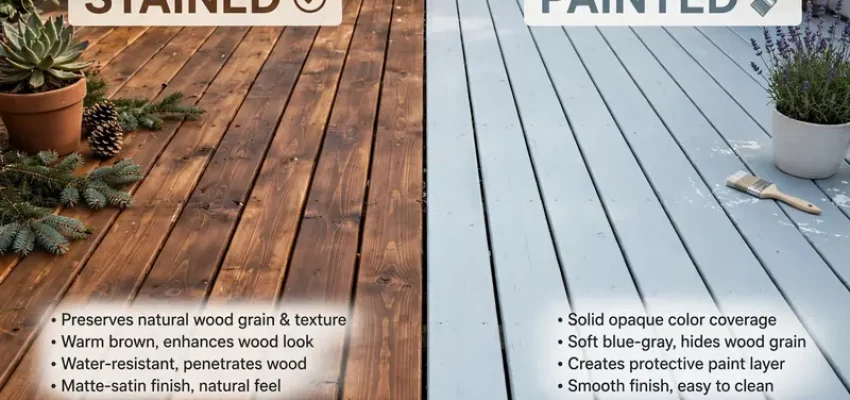
At the most basic level, the deck staining vs painting question comes down to how each product interacts with wood. Stain penetrates into the wood fibers, enhancing the natural grain while providing protection from within. Paint sits on top of the wood as a protective film, completely covering the grain with opaque color. This fundamental difference drives every other distinction between the two.
Because stain soaks in, it moves with the wood as it expands and contracts with temperature and moisture changes. Paint forms a rigid shell that can crack and peel when the wood beneath it moves — which is why painted decks in USA climates with big temperature swings often need more frequent attention. Understanding this helps explain why the deck staining vs painting decision matters so much for long-term satisfaction.
Appearance: Natural Look vs Bold Color
In the deck staining vs painting comparison, appearance is often the deciding factor. Stain showcases wood’s natural beauty — the grain patterns, knots, and color variations that make each board unique. Transparent and semi-transparent stains let the wood show through while adding warm tones like cedar, redwood, or walnut. Even solid-color stains retain subtle texture that reads as “wood” rather than “painted surface.”
Paint offers unlimited color options and a clean, uniform look that works beautifully with modern, coastal, or cottage-style USA homes. A crisp white, navy, or charcoal painted deck can look stunning against the right house. However, paint completely hides the wood grain, which some homeowners feel defeats the purpose of having a wooden deck. If you love the look of natural wood, stain wins the deck staining vs painting debate on appearance alone. For coordinating interior updates, our interior house painting cost in USA 2026 guide covers full-room budgeting.
Consider your home’s overall style too. Traditional and rustic homes usually look best with stained decks that complement the natural setting. Contemporary homes with bold exterior colors can carry a painted deck beautifully. For coordinating with your home’s exterior palette, our best paint colors for resale value guide offers useful perspective on color choices that appeal to USA buyers.
Durability and Lifespan Comparison
Durability is where the deck staining vs painting comparison gets interesting. A quality stain job typically lasts two to four years on horizontal deck surfaces before needing reapplication, though vertical railings can go five or more years. When stain wears, it fades gradually — you simply clean and recoat without stripping.
A quality paint job on a deck can last five to seven years, potentially longer on railings and vertical surfaces. But when paint fails, it fails dramatically: peeling, flaking, and chipping that require scraping, sanding, and sometimes full stripping before repainting. In the deck staining vs painting longevity debate, paint lasts longer per application but demands far more work when it eventually fails.
Climate plays a huge role. In the rainy Pacific Northwest or humid Southeast USA, moisture constantly challenges both finishes, but stain’s penetrating nature handles it more gracefully. In the intense sun of Arizona or Texas, UV breaks down both products, though quality stains with UV blockers and quality exterior paints both offer protection. For more on how long exterior coatings last, see our how long exterior paint lasts in USA guide.
Deck Staining vs Painting: Cost Breakdown
For the deck staining vs painting cost comparison, stain is generally cheaper both in materials and labor. Quality deck stain runs $30 to $60 per gallon in the USA, and an average 300-square-foot deck needs three to five gallons for two coats — roughly $100 to $300 in materials for DIY. Professional staining typically costs $2 to $4 per square foot, or $600 to $1,200 for that same average deck.
Quality exterior deck paint costs $35 to $70 per gallon, with similar coverage needs — $120 to $350 in DIY materials. However, painted decks almost always require primer, adding $25 to $50 per gallon and an extra coat of labor. Professional deck painting runs $3 to $6 per square foot in the USA, or $900 to $1,800 for an average deck. The prep work for paint is also more intensive, which drives up professional quotes.
Long-term costs favor stain for most homeowners. Because re-staining requires only cleaning and recoating while repainting often requires stripping failed paint first, the lifetime maintenance cost of stain is typically lower. When budgeting your project, our exterior house painting cost USA 2026 guide provides useful context on professional exterior coating rates.
Maintenance Requirements
The deck staining vs painting maintenance comparison strongly favors stain for ease. Maintaining a stained deck means annual cleaning with a deck cleaner and reapplying stain every two to four years. There is no scraping, no sanding between coats — just clean, dry, and recoat. Most USA homeowners can re-stain a deck in a single weekend.
Maintaining a painted deck requires more vigilance. You need to watch for chips, cracks, and peeling, touching up promptly to prevent moisture from getting under the paint film. Once peeling starts, it spreads. A full repaint typically involves scraping all loose paint, sanding edges smooth, spot-priming bare wood, then applying two topcoats — a multi-day project. For decks in harsh USA climates, this cycle may come every four to five years.
Slip resistance is another maintenance-adjacent factor. Stained wood retains natural texture that provides decent traction. Painted surfaces, especially with semi-gloss or gloss finishes, can become slippery when wet. If you choose paint, add a non-slip additive to the final coat or select a paint specifically formulated for deck floors with texture built in. Our paint sheen guide for USA homes explains how finish choice affects traction and durability.
Application Difficulty: DIY Comparison
For DIYers weighing deck staining vs painting, stain is significantly more forgiving. Stain does not show brush marks, roller lines, or lap marks the way paint does. You can apply it with a brush, roller, or pump sprayer, and minor inconsistencies blend into the wood grain naturally. A first-timer can achieve professional-looking results with stain on their first attempt.
Paint demands more skill and patience. Every brush stroke shows, drips are obvious, and achieving even coverage on rough wood requires careful technique. Paint also requires more thorough prep — any mill glaze, gray weathered fibers, or previous coatings must be addressed or the paint will not adhere. If you are new to exterior finishing, stain is the safer DIY choice in the deck staining vs painting decision. For larger jobs you would rather outsource, our how to choose a house painter in USA guide covers vetting contractors.
Whichever you choose, preparation determines the outcome. Clean the deck thoroughly with a deck cleaner or light pressure wash, let it dry for at least 48 hours, and sand any rough spots or splinters. Our surface preparation guide covers the fundamentals that apply to any exterior coating project.
When Stain Is the Better Choice
Choose stain in the deck staining vs painting decision when: your deck wood is in good condition with attractive grain you want to showcase; you prefer a natural, rustic look; you want the easiest maintenance and recoating process; your deck gets heavy foot traffic (stain hides wear better); you live in a climate with extreme temperature swings; or you are DIYing and want the most forgiving application.
Stain is also better for older decks with minor imperfections. Semi-transparent and solid-color stains can mask gray weathering and small flaws while still looking like wood. If your deck boards are structurally sound but cosmetically tired, a quality solid stain can make them look nearly new without the commitment and maintenance burden of paint.
When Paint Is the Better Choice
Choose paint in the deck staining vs painting decision when: you want a specific bold color that stain cannot achieve; your home’s style calls for a crisp, uniform look; the deck wood is in poor cosmetic condition with stains, discoloration, or mismatched repairs that stain will not hide; you are painting railings and trim to match house trim; or maximum longevity between full refinishes is your top priority.
Paint is also the answer when covering previously painted wood — switching from paint to stain requires stripping all the old paint first, which is labor-intensive. If your deck is already painted and the paint is mostly sound, repainting is far easier than converting to stain. Similarly, pressure-treated lumber that is still greenish from treatment takes paint well once fully dried.
Can You Switch Between Stain and Paint?
A common follow-up to the deck staining vs painting question is whether you can change your mind later. Going from stain to paint is straightforward: clean, lightly sand, prime with a quality exterior bonding primer, and paint. The stain underneath does not interfere with paint adhesion as long as the surface is clean and dull.
Going from paint to stain is much harder. You must remove all the old paint completely — through chemical stripping, heavy sanding, or both — before stain can penetrate the wood. Any paint left behind will show as blotchy spots where stain cannot absorb evenly. This is a major project, so choose carefully the first time. If you are unsure, start with stain; you can always paint over it later, but the reverse is a ordeal.
The Verdict on Deck Staining vs Painting
For most USA homeowners, stain is the better default choice in the deck staining vs painting debate. It is cheaper, easier to apply, simpler to maintain, more forgiving of wood movement, and showcases the natural beauty of wood. The gradual fade of stain is far less alarming than the peeling failure of paint, and recoating is a simple weekend job rather than a major restoration.
Paint earns its place for specific situations — bold design statements, covering damaged wood, matching house trim, or maximizing time between full refinishes. If you choose paint, invest in premium products and meticulous prep, because the quality of the job determines whether you get seven good years or two bad ones.
Whichever side of the deck staining vs painting question you land on, proper preparation and quality products make all the difference. Clean thoroughly, let the wood dry completely, and do not cut corners on the coating itself. For related exterior projects, check our exterior painting cost guide, exterior paint lifespan article, and front door painting USA guide. Your deck is an outdoor living room — treat it to a finish that protects it and makes you want to spend time on it.