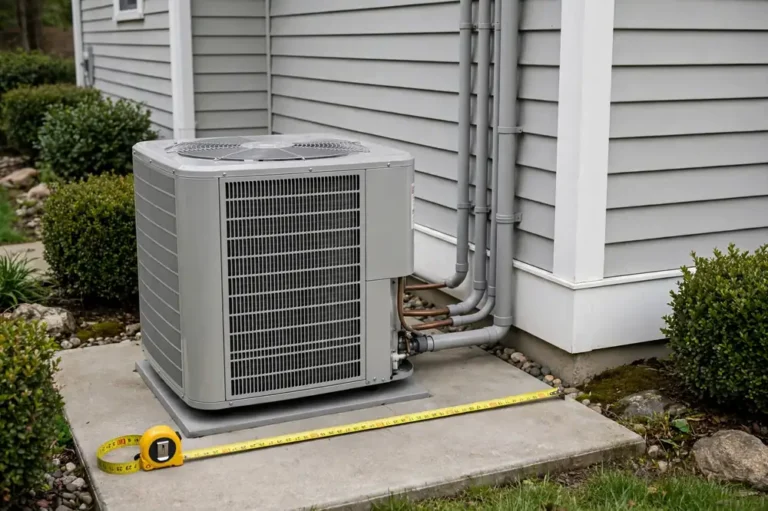
Imagine cutting your heating and cooling bills by 50 to 70% for the next quarter-century while barely thinking about your HVAC system. That is the promise of geothermal energy — and it is the reason a growing number of American homeowners are investigating the geothermal heating cost for homes despite the steepest upfront price tag in residential HVAC. This guide breaks down exactly what geothermal costs in the USA in 2026, what drives the price, available tax credits that slash the net cost, and whether the decades-long payback makes sense for your home.
Geothermal heat pumps (also called ground-source heat pumps) tap the earth’s stable underground temperature — roughly 50 to 60°F year-round just a few feet below the surface across most of the USA. In winter, the system extracts heat from the ground and concentrates it for your home; in summer, it dumps indoor heat back underground. Because it moves heat rather than creating it by burning fuel, geothermal delivers 300 to 500% efficiency compared to 95% for the best gas furnace. The geothermal heating cost for homes is high upfront precisely because you are installing a 50-year underground energy asset, not just an appliance.
Average Geothermal Heating Cost for Homes in the USA
In 2026, the total installed geothermal heating cost for homes in the USA ranges from $20,000 to $45,000 for a typical 2,000-square-foot residence, with most homeowners paying $25,000 to $35,000 before tax credits. This includes the ground loop (the underground piping), the indoor heat pump unit, ductwork modifications, excavation or drilling, and all electrical and controls work.
That sticker shock needs context: the federal Investment Tax Credit currently covers 30% of the total installed cost with no cap, immediately cutting a $30,000 system to $21,000 net. Many states and utilities add their own rebates of $1,000 to $5,000, and some offer low-interest financing specifically for geothermal. After incentives, the net geothermal heating cost for homes often lands between $15,000 and $25,000 — still premium-priced, but within reach of a high-end conventional system replacement plus ductwork.
Compare that to conventional alternatives: a high-efficiency furnace plus central AC runs $8,000 to $15,000 installed; a premium cold-climate air-source heat pump system runs $10,000 to $20,000. Geothermal costs roughly double — but then cuts operating costs in half for decades. The question is never just price; it is price divided by 25 years of savings.
What Drives Geothermal Heating Cost: The Ground Loop
The ground loop — hundreds of feet of high-density polyethylene pipe buried underground — accounts for 40 to 60% of total project cost and is the main reason geothermal costs vary so widely. Three loop configurations dominate US installations, each with different cost profiles.
Horizontal Loops: $15,000–$25,000 Total System Cost
Horizontal loops bury pipe 4 to 6 feet deep in trenches across a large yard area — typically 1,500 to 3,000 square feet of open land for an average home. Trenching with an excavator is the cheapest loop installation method, making horizontal systems the most affordable geothermal option. The tradeoff is space: you need a big, clear yard, and the trenching tears up landscaping that must be restored.
Horizontal loops suit suburban and rural properties with room to dig. In cold northern climates, trenches must go deeper (6+ feet) to stay below the frost line, adding cost. Slinky-style coiled pipe reduces trench length by packing more pipe per foot of trench, a common cost-saving technique.
Vertical Loops: $25,000–$45,000 Total System Cost
Vertical loops drill boreholes 150 to 400 feet deep, requiring only a small surface footprint — ideal for urban and small suburban lots. But drilling is expensive: $15,000 to $30,000 for the boreholes alone, depending on depth, geology, and local drilling rates. Hard rock formations can double drilling costs versus easy soil.
Despite the premium, vertical loops are the most common configuration in the USA because most homeowners lack the yard space for horizontal trenches. They also perform slightly better — deeper ground temperatures are more stable year-round. If your property is under a quarter-acre, vertical is likely your only option, and the geothermal heating cost for homes on small lots reflects that reality.
Pond or Lake Loops: $18,000–$28,000 Total System Cost
If you have a suitable pond or lake within reach — at least half an acre, 8+ feet deep — coiled pipe can be sunk directly in the water. This is the cheapest loop type because there is no trenching or drilling, just pipe and placement. Few homeowners have this option, but those who do get geothermal’s best value proposition.
The Indoor Heat Pump Unit: $8,000–$15,000
The indoor geothermal heat pump unit itself — the cabinet containing the compressor, heat exchangers, and controls — costs $8,000 to $15,000 installed, including connection to your ductwork and electrical panel. This is comparable to a premium conventional heat pump. Units come in forced-air configurations (connecting to standard ducts) and water-to-water configurations (feeding radiant floor systems or hot water).
Geothermal heat pumps last 20 to 25 years for the indoor unit — similar to conventional equipment — but the ground loop carries a 50-year warranty and typically lasts 50+ years in practice. When the indoor unit eventually needs replacement ($8,000 to $12,000), you reuse the existing loop, making the second-generation cost dramatically lower. This two-stage economics is unique to geothermal and central to its long-term value.
Tax Credits and Incentives That Cut Geothermal Costs
The federal Investment Tax Credit (ITC) is geothermal’s biggest financial lever: 30% of the total installed cost, including the ground loop, with no maximum cap, claimed on your federal tax return. On a $30,000 system, that is $9,000 back. Unlike some energy credits, the geothermal ITC covers the entire project — drilling, trenching, equipment, and installation labor. Verify current law before committing, as credit percentages are subject to legislative change.
State incentives stack on top. New York offers rebates up to $5,000 through NYSERDA; Maryland, Massachusetts, and several other states have rebate or grant programs. Many electric utilities offer geothermal rebates of $500 to $2,000 or special heat-pump electricity rates that cut operating costs further. Some states exempt geothermal equipment from sales tax or offer property tax exclusions so the system does not raise your assessed value. The Database of State Incentives for Renewables (DSIRE) lists every program by zip code — check it before getting quotes.
Financing is widely available: FHA PowerSaver loans, state green banks, and utility on-bill financing spread the net cost over 10 to 20 years, often with monthly payments below the energy savings — meaning the system cash-flows positive from day one. When evaluating the geothermal heating cost for homes, always calculate the financed monthly cost against current heating bills, not just the lump-sum sticker price.
Operating Costs and Payback Period
Here is where geothermal earns its premium. A typical American home spending $2,500 annually on heating and cooling can expect geothermal to cut that to $800 to $1,200 — savings of $1,300 to $1,700 per year. Against a net cost of $20,000 after credits, simple payback lands at 12 to 15 years. Against rising energy prices — and fossil fuel prices have risen faster than inflation for decades — payback accelerates.
But simple payback understates the value. Over 25 years, cumulative savings of $35,000 to $45,000 dwarf the net investment. Add avoided replacement costs (a conventional system needs replacing at year 15 to 20; the geothermal loop does not), reduced maintenance (no outdoor condenser exposed to weather, no combustion components), and a documented resale premium — studies show geothermal homes sell faster and for 3 to 7% more. For homeowners planning to stay 10+ years, the math is compelling.
Operating costs are also remarkably stable: you are buying mostly electricity at residential rates, not volatile heating oil, propane, or natural gas. Households currently heating with oil or propane — common in the Northeast — see the fastest payback, often under 10 years, because their baseline fuel costs are so high. Our comparison of heat pump vs furnace for US homes shows baseline costs for conventional alternatives.
Is Your Home a Good Candidate?
Geothermal works best for homeowners planning to stay at least 10 years, with suitable land or drilling access, currently high heating/cooling bills, and existing or planned ductwork. New construction is ideal — the loop goes in before landscaping, marginal cost is lowest, and the 30% credit applies to the whole project. Major renovations and additions are the next-best opportunity.
Poor candidates include homes on tiny urban lots where drilling is impractical or prohibited, households planning to move within five years (you will not recoup the premium), and homes with very low energy bills where savings cannot justify the investment. Rocky geology, high water tables, or restricted drilling access can also inflate the geothermal heating cost for homes beyond reason — a site assessment ($500 to $1,000, often credited toward installation) answers these questions definitively.
Soil thermal conductivity testing, available from geothermal designers, predicts loop performance for your specific property. Do not skip this on marginal sites — an undersized loop is the number one cause of disappointing geothermal performance, and it is entirely preventable with proper design.
Finding a Qualified Geothermal Installer
Geothermal is a specialty trade — your average furnace-and-AC shop may not do it. Look for installers certified by the International Ground Source Heat Pump Association (IGSHPA), with at least 20 completed residential loop installations and references you can visit. Ask for Manual J load calculations, loop design documentation, and itemized quotes separating loop costs from equipment costs.
Get three quotes minimum; geothermal bids vary more than conventional HVAC because loop costs depend on site-specific factors that estimators assess differently. Verify drilling subcontractors are licensed in your state. Confirm who handles permits — most jurisdictions require well-drilling permits for vertical loops. Our general contractor vetting checklist in choosing the right HVAC contractor in the USA applies, with the added filter of IGSHPA certification.
Planning a full heating system upgrade? Compare your options with our guides to AC replacement cost in the USA, furnace replacement cost, HVAC system lifespan, thermostat installation, HVAC repair costs, AC sizing, maintenance plans, and lowering your heating bill.
Frequently Asked Questions
How long do geothermal systems last?
Indoor heat pump units last 20 to 25 years — comparable to conventional equipment. The underground loop lasts 50+ years with a 50-year warranty standard. When the indoor unit is eventually replaced, you keep the loop, making second-generation costs far lower than the initial installation.
Does geothermal work in cold climates?
Yes — brilliantly. Ground temperatures stay stable regardless of air temperature, so geothermal efficiency does not degrade in cold weather the way air-source heat pumps do. Minnesota, Maine, and North Dakota have thriving geothermal markets precisely because the technology excels where winters are harshest.
Will geothermal tear up my entire yard?
Horizontal loops disturb a large area but restoration is straightforward — topsoil is replaced and reseeded. Vertical loops need only a drill rig’s access path and a few small borehole sites. Most yards recover fully within one growing season. Discuss restoration specifics in your contract.
Can geothermal cool my home too?
Absolutely — and very efficiently. Summer cooling rejects indoor heat into the cool ground, achieving effective efficiencies far beyond even the best conventional air conditioners. Many homeowners report their lowest-ever summer electric bills after switching, even in hot climates like Texas and Arizona.
The geothermal heating cost for homes is undeniably the highest in residential HVAC — but it buys the lowest operating costs, the longest-lived infrastructure, and the smallest carbon footprint of any heating and cooling option available to American homeowners. With the 30% federal credit, state incentives, and financing that often cash-flows from day one, geothermal deserves a serious look from any homeowner planning to stay put and thinking in decades rather than years.