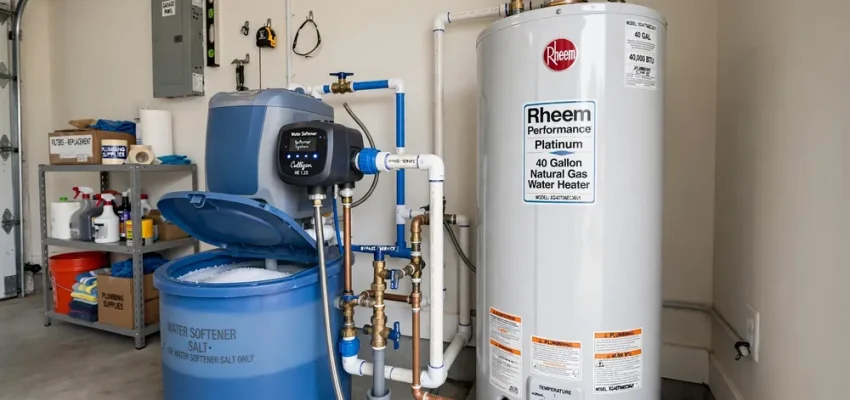

Hard water causes scale buildup in pipes, spots on dishes, stiff laundry, dry skin, and premature appliance failure. If you are tired of these problems, understanding the water softener installation cost is your first step toward softer water throughout your home. A quality water softener protects your plumbing, extends appliance life, and improves daily comfort — making it one of the smartest investments for USA homeowners in hard-water regions.
The average water softener installation cost in the USA ranges from $800 to $3,000, with most homeowners paying around $1,500 for a whole-house system professionally installed. DIY installation can reduce costs to $400–$1,000 for the unit alone. This guide covers system types, sizing, cost factors, installation process, maintenance, and how to determine if your home needs a softener.
Do You Need a Water Softener?
About 85% of the USA has hard water, but severity varies dramatically by region. The Midwest, Southwest, and parts of Texas, Florida, and California have the hardest water, often exceeding 10 grains per gallon (GPG). The USGS classifies water above 7 GPG as “very hard.” If your water tests above 7 GPG, a softener will make a noticeable difference.
Signs you need a water softener include white scale deposits on faucets and showerheads, spots on glasses and dishes after washing, laundry that feels stiff or looks dingy, dry itchy skin and dull hair after showering, low water pressure from scale-clogged pipes, and appliances (water heater, dishwasher, washing machine) failing prematurely. A simple $15–$25 home test kit from any hardware store measures your water hardness in minutes. For the most accurate results, order a professional lab test ($50–$150) that also checks for iron, manganese, pH, and other contaminants affecting your water softener installation cost calculations.
Hard water costs the average USA family hundreds of dollars per year in excess soap and detergent, higher energy bills (scale makes water heaters work harder), appliance repairs, and plumbing maintenance. A water softener typically pays for itself within 2–4 years through these savings alone.
Average Water Softener Installation Cost in the USA
The typical water softener installation cost breaks down into equipment ($400–$2,500) and professional labor ($200–$600). Most whole-house systems installed by a licensed plumber total $1,000–$2,500. Premium high-capacity or smart systems with advanced features can reach $3,000–$4,000 installed.
Where the softener is installed affects labor costs significantly. The ideal location is near where the main water line enters your home, before it branches to the water heater — this ensures all hot and cold water is treated. If this location has easy access, good drainage for the backwash cycle, and a nearby electrical outlet, installation is straightforward. Difficult locations (tight crawl spaces, no nearby drain, no outlet) add $100–$300 in labor.
Regional price differences follow typical USA plumbing labor patterns. Expect to pay 20–40% above average in high-cost metros like San Francisco, New York, or Boston, and 10–20% below average in the Midwest and Southeast. Always get multiple quotes from licensed plumbers or water treatment specialists. If you are planning broader plumbing upgrades, our bathroom plumbing rough-in cost guide helps with overall project budgeting, and water treatment system comparisons covers all your options.
Water Softener Installation Cost by System Type
Salt-Based Ion Exchange: $800–$2,500 Installed
The gold standard for hard water treatment, salt-based softeners use ion exchange resin to remove calcium and magnesium. These systems are highly effective, handling hardness up to 25+ GPG. The water softener installation cost for salt-based systems is moderate, but factor in ongoing salt costs ($50–$100/year) and periodic resin replacement (every 8–12 years, $200–$400).
Salt-based systems require a drain for the regeneration backwash cycle and a 110V outlet for the control valve. They add a small amount of sodium to your water — negligible for most people, but those on strict low-sodium diets may prefer a reverse osmosis drinking water system for the kitchen tap.
Salt-Free Water Conditioners: $800–$2,000 Installed
Salt-free systems use template-assisted crystallization (TAC) to prevent scale without removing minerals. They do not actually “soften” water by the technical definition, but they effectively prevent scale buildup. Advantages include no salt, no wastewater from regeneration, no electricity needed for some models, and retention of beneficial minerals. However, they do not help with soap scum, spots, or the “slippery” soft-water feel some homeowners love.
The water softener installation cost for salt-free systems is comparable to salt-based, but maintenance is simpler — just replace the TAC cartridge every 3–5 years ($200–$400). These are excellent choices where salt discharge is restricted by local regulations, as in parts of California.
Dual-Tank Softeners: $1,500–$3,500 Installed
Dual-tank systems use two resin tanks that alternate — while one regenerates, the other provides soft water. This means unlimited soft water with no downtime, ideal for large families, homes with high water usage, or commercial applications. The higher water softener installation cost reflects the additional tank and more complex valve system.
Magnetic and Electronic Descalers: $200–$600
These devices clamp onto your main water pipe and claim to alter mineral behavior using magnetic fields or electronic pulses. They are the cheapest option and require no plumbing modifications. However, scientific evidence for their effectiveness is weak, and most water treatment professionals do not recommend them as a primary solution. If your hardness exceeds 10 GPG, invest in a proven system instead.
What Size Water Softener Do You Need?
Proper sizing is critical — an undersized softener regenerates too frequently (wasting salt and water), while an oversized unit costs more upfront than necessary. Size is measured in grain capacity, typically 24,000 to 80,000 grains for residential USA homes.
Investing in a quality water softener not only enhances the comfort and longevity of your home’s plumbing system but also serves as a crucial step in maintaining your property’s overall value. However, as homeowners address issues related to hard water, they may also need to consider the condition of their existing plumbing. For those whose homes were built before the 1990s, the risks associated with aging pipes can become increasingly apparent, manifesting in problems such as rusty water and reduced water pressure. In such cases, understanding the Repiping a house cost becomes essential, as it can significantly impact both safety and functionality. By comparing the costs of water softener installation with potential repiping needs, homeowners can make informed decisions that prioritize both immediate comfort and long-term investment.
Calculate your needs: multiply your water hardness (GPG) by daily water usage (gallons) by 7 days, then choose a system with at least that grain capacity. Example: 10 GPG hardness × 250 gallons/day (family of 4) × 7 days = 17,500 grains/week. A 24,000-grain softener handles this comfortably with margin. Most USA families need 32,000–48,000 grain systems.
When in doubt, size up slightly. The price difference between a 32,000 and 48,000 grain system is usually only $100–$200, but the larger unit regenerates less often, saving salt and water over its lifetime. A water treatment professional can perform precise calculations based on your lab test results and household usage patterns. Oversizing also provides headroom if your family grows.
Professional Installation Process
Understanding the installation process helps you evaluate quotes and ensure quality work for your water softener installation cost. A typical professional installation takes 2–4 hours.
Step 1: Water testing and site assessment. The installer verifies your water hardness, checks the main water line location, identifies drain options for backwash, and confirms electrical access. This takes 15–30 minutes.
Step 2: Shutting off water and cutting the main line. The main water supply is shut off, the line is cut at the chosen location, and bypass valves are installed. The bypass allows you to isolate the softener for maintenance without losing water to the house — insist on this feature.
Step 3: Connecting the softener. The softener’s inlet and outlet are plumbed into the main line, the drain line is run to a suitable discharge point (floor drain, utility sink, or standpipe), and the overflow hose from the brine tank is positioned. All connections are pressure-tested.
Step 4: Programming and startup. The installer programs your water hardness, sets regeneration timing (typically 2 AM when water is not in use), adds salt to the brine tank, and runs an initial regeneration cycle. They should explain the settings and show you how to add salt and bypass the system.
Verify that your installer pulls any required permits. Most USA jurisdictions do not require permits for water softener installation, but some areas with salt discharge restrictions do. Your installer should know local requirements. For related fixture work during the same visit, see kitchen sink installation cost for bundling opportunities and plumbing permit guide for code compliance.
Ongoing Maintenance and Operating Costs
Beyond the initial water softener installation cost, budget for ongoing maintenance to keep your system performing optimally. Salt costs $5–$10 per 40-pound bag, with most families using 2–4 bags per month depending on hardness and usage — roughly $120–$300 per year. Use high-purity evaporated salt pellets to minimize brine tank sludge.
Check salt levels monthly and keep the brine tank at least half full. Clean the brine tank annually to remove sediment buildup. Inspect the resin bed every few years — iron fouling is the most common resin killer. If your water has iron above 0.5 ppm, install a pre-filter or iron removal system to protect the softener resin.
Most quality softeners last 15–20 years with proper maintenance. The control valve may need servicing around year 10 ($150–$300). Resin replacement at year 10–15 costs $200–$400 and essentially gives your system a new life. These maintenance costs are modest compared to the damage hard water inflicts on plumbing and appliances. Homeowners in very hard water areas should also review how to prevent frozen pipes in winter since softened water behaves slightly differently in extreme cold.
DIY vs. Professional Water Softener Installation
Handy homeowners can save $200–$600 in labor by installing a water softener themselves. The process requires cutting into your main water line, soldering or using push-fit connections, running a drain line, and programming the control valve. If you are comfortable with basic plumbing, it is very achievable in half a day.
However, mistakes in the main water line are high-stakes — a bad connection here floods your home. If you have never soldered copper pipe, practice first or use SharkBite push-fit fittings designed for DIYers. Ensure you understand your local code requirements for backflow prevention; many jurisdictions require a specific air gap on the drain line.
Professional installation is worth the water softener installation cost premium if your main line is difficult to access, you need electrical work for the outlet, your water has complicating factors (high iron, low pH), or you simply want warranty protection. Most manufacturers honor warranties regardless of installer, but professional installation often includes a labor warranty for the first year.
Final Thoughts on Water Softener Installation Cost
The water softener installation cost of $800–$3,000 is a sound investment for USA homeowners battling hard water. Beyond the immediate comfort improvements — softer skin, cleaner dishes, brighter laundry — a softener protects your plumbing system, extends water heater and appliance life by years, and reduces energy and detergent costs. Most families recoup the investment within 2–4 years.
Get your water professionally tested, size the system correctly, and hire a qualified installer for the best results. Whether you choose salt-based ion exchange or a salt-free conditioner, addressing hard water improves your daily quality of life in tangible ways. For more USA home water system guides, explore toilet installation costs, whole-house water filter cost, reverse osmosis system installation, water heater installation cost, and hard water test kit guide to plan your complete home water treatment strategy.