
Water always finds the lowest point — and if that point is your basement or crawl space, the damage adds up fast. Stained walls, musty smells, ruined flooring, and in the worst cases, foundation damage that costs tens of thousands to fix. A French drain is one of the most effective defenses a homeowner can install, which is why French drain cost is one of the most-searched drainage questions in the USA.
In 2026, professional French drain installation costs $2,800–$6,500 for a typical residential project, or roughly $20–$50 per linear foot. Exterior drains (around the foundation perimeter) run higher than interior drains (along the inside of basement walls) because of excavation. This guide covers real 2026 French drain cost data, interior versus exterior systems, what drives the price, and how to make sure the system actually solves your water problem instead of just moving it.
How Much Does a French Drain Cost in 2026?
The national average French drain cost for a standard residential installation falls between $4,000 and $5,000 in 2026. Most projects land in the $2,800–$6,500 range, but large homes, difficult soil, or systems that include a sump pump can push past $10,000.
Per-linear-foot pricing is the industry standard: $20–$35 per linear foot for interior French drains and $40–$60 per linear foot for exterior drains. A typical project covers 100–150 linear feet. So a 120-foot interior drain at $28 per foot costs about $3,360, while the same length installed outside the foundation at $50 per foot runs about $6,000.
Those numbers cover the drain itself — perforated pipe, gravel bed, filter fabric, and labor. They do not always include extras like a sump pump installation ($1,000–$2,500), concrete cutting and repouring for interior systems ($500–$1,500), or landscape restoration for exterior work ($500–$2,000). Always ask for an itemized quote so you can see exactly what is included.
Interior vs Exterior French Drains: Cost and Use Cases
Interior French Drains: $2,800–$5,000
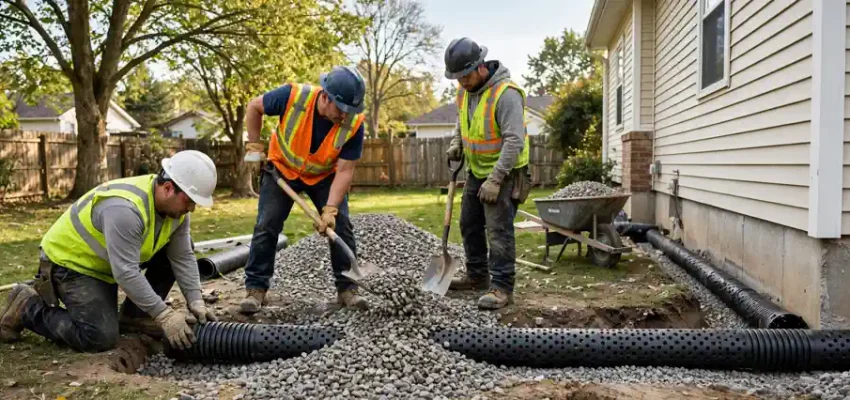
An interior French drain runs along the inside perimeter of your basement or crawl space, usually installed by cutting a trench in the concrete slab next to the foundation wall. Water that seeps through the wall or up through the floor joint is captured by the perforated pipe and directed to a sump pump, which discharges it outside.
Interior systems are cheaper because there is no deep excavation, no soil hauling, and no landscape destruction. They are the go-to solution for existing homes with water intrusion, and they work even when exterior access is blocked by patios, decks, or neighboring structures. The tradeoff: installation is disruptive (concrete cutting inside your home) and the system manages water after it enters rather than stopping it outside. Interior drains pair naturally with basement waterproofing and crawl space encapsulation for a complete moisture defense.
Exterior French Drains: $5,000–$12,000
An exterior French drain is installed around the outside of the foundation, typically 4–6 feet deep at the footing level. It intercepts groundwater before it ever reaches your foundation walls — the most thorough solution available, and the standard for new construction.
The higher French drain cost for exterior work comes from excavation: digging a deep trench around part or all of the foundation, hauling soil, protecting or replacing the waterproof membrane on the wall, and restoring landscaping, walkways, or driveways afterward. For homes with chronic hydrostatic pressure or where interior systems cannot keep up, exterior drainage is worth every penny. It is also the right call when foundation repair work is already planned — the excavation is open anyway, so adding drainage adds relatively little.
Yard and Surface French Drains: $1,500–$4,000
Not every French drain protects a foundation. Shallow “curtain” or yard drains ($15–$30 per linear foot) redirect surface water away from soggy lawns, pooling patios, and downspout discharge zones. A 100-foot yard drain typically costs $1,500–$3,000. These are simpler trenches — 12–18 inches deep — and many experienced DIYers tackle them, though proper slope (at least a 1% grade) is critical and easy to get wrong.
What Affects French Drain Cost?
Length of the drain. This is the biggest driver — cost scales almost linearly with linear footage. A partial 60-foot drain for one wet wall costs far less than a 160-foot full-perimeter system.
Interior versus exterior. As shown above, exterior installation roughly doubles the per-foot price because of excavation depth and restoration.
Soil and access conditions. Rocky soil, high water tables, and tight access for excavators all slow the work and raise labor costs. Clay soil — common across much of Texas and the Southeast — drains poorly and often requires deeper, more extensive systems.
Sump pump and discharge. Interior systems need a sump pump ($1,000–$2,500 installed); exterior systems need a daylight outlet or dry well. Long discharge runs and freeze-protection add cost.
Concrete and finish work. Interior drains require cutting and repouring concrete ($500–$1,500). Exterior drains may require removing and replacing patios, walkways, or landscaping ($500–$2,000+).
Permits and engineering. Some municipalities require drainage permits ($100–$400), and complex sites may need a drainage plan from an engineer ($500–$1,500). Skipping permits risks stop-work orders and problems at resale — the same reason you pull permits for major contractor projects.
Signs You Need a French Drain
Water stains or efflorescence (white mineral deposits) on basement walls, puddles that appear after rain, a musty smell that never fully goes away, and sump pumps that run constantly are all classic signs. Outside, look for soil erosion near the foundation, mulch beds that wash out, and standing water that lingers more than 24 hours after rain.
Before committing to a full system, rule out simpler fixes: clogged gutters, downspouts discharging at the foundation, and negative grading (soil sloping toward the house) cause a surprising share of basement water problems — and regrading costs a fraction of a French drain. A good contractor diagnoses first and sells second. If you are seeing active leaks, review how to detect a water leak in your home to pinpoint the source before you pay for drainage.
French Drain vs Alternatives
Grading and downspout extensions ($500–$2,000) should always come first — they solve surface-water problems without buried pipe. Sump pump alone ($1,000–$2,500) handles water that already collects in a pit but does not intercept it across the wall. Exterior waterproof membranes ($8,000–$15,000+) seal the wall itself and are often combined with exterior French drains on high-end jobs. Repiping-style spot fixes do not apply here — drainage is a system, not a patch.
For most homeowners with genuine groundwater intrusion, the winning combination is an interior French drain plus sump pump, often with wall-sealing and dehumidification. It is the best ratio of cost to effectiveness, which is why it dominates residential drainage work.
How to Hire a French Drain Contractor
Drainage is specialized work — a general handyman is not the right hire. Look for basement waterproofing or drainage contractors with at least 5 years of local experience, and ask for addresses of past jobs you can drive by. Get three written quotes with identical scope (linear feet, pipe type, gravel depth, fabric, pump specs, restoration) so you are comparing apples to apples.
Ask about the pipe: rigid PVC with slots outperforms flexible corrugated pipe, which can crush and clog. Ask about filter fabric (“sock”) around the pipe and cleanouts for future maintenance. Confirm who handles permits and what the warranty covers — reputable contractors warranty the system (not just the pump) for 10+ years, often transferable to the next owner. Verify licensing and insurance, and never pay more than 30–50% upfront. These are the same screening fundamentals that apply when comparing drain cleaning providers or evaluating sewer line replacement bids.
Maintaining Your French Drain
A properly installed French drain needs little maintenance, but “little” is not “none.” Keep gutters clean so the system is not overwhelmed, make sure the discharge outlet stays clear of mulch and debris, and test the sump pump twice a year by pouring water into the pit. If you have cleanouts, flush the line every few years. Consider a battery backup for the pump — power outages love to coincide with the storms that cause flooding. Annual attention here costs almost nothing and protects a multi-thousand-dollar investment, much like routine plumbing checkups protect your pipes.
French Drain Cost FAQs
How long does a French drain last?
A properly installed system with rigid pipe, filter fabric, and clean gravel lasts 30–50 years. Flexible corrugated pipe without fabric can clog with silt in 10–15 years, which is why material choice matters.
Can I install a French drain myself?
Shallow yard drains are a realistic DIY project ($500–$1,000 in materials). Interior and deep exterior foundation drains are not — they require concrete cutting or heavy excavation, precise slope, and knowledge of local codes. Mistakes here cause the exact flooding you are trying to prevent.
Does a French drain increase home value?
It does not add appraised value the way a kitchen remodel does, but it removes a major buyer objection. A documented, warranted drainage system can be the difference between a sale and a walk-away in wet markets.
How deep should a French drain be?
Foundation drains go 4–6 feet deep at the footing level. Yard curtain drains are typically 12–24 inches deep. Depth is dictated by what you are intercepting — footing drains must reach the footing.
The Bottom Line on French Drain Cost
At $2,800–$6,500 for most homes, a French drain is a mid-range home investment that protects against some of the most expensive damage a house can suffer — foundation failure, chronic mold, and ruined finished basements. Start with the cheap fixes (grading, gutters, downspouts), diagnose carefully, then hire a drainage specialist — not a generalist — with an itemized quote, quality materials, and a long transferable warranty. Done right, it is the kind of invisible infrastructure, like solid exterior maintenance, that quietly protects everything visible above it for decades.