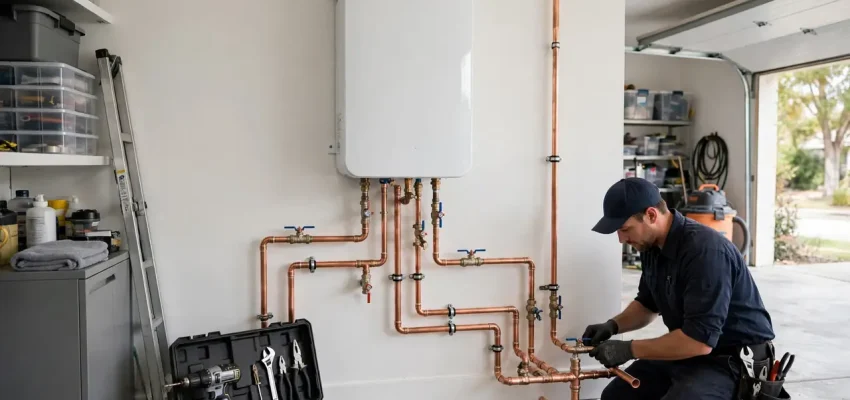

Endless hot water, lower energy bills, and a unit the size of a suitcase instead of a hulking tank — tankless water heaters have a lot to love. But they also carry one of the widest price ranges of any home upgrade, and the quotes homeowners receive can feel all over the map. What is tankless water heater cost in 2026, and what actually determines whether your project lands at $1,500 or $4,000?
According to 2026 Angi data, tankless water heater installation averages $2,641, with most projects falling between $1,406 and $3,902. Small electric point-of-use units can cost under $500 installed, while large gas whole-house systems with venting and gas-line upgrades can exceed $5,000. This guide breaks down 2026 equipment and installation prices, the cost drivers that move quotes, energy savings and payback, and how tankless compares to tank and heat-pump alternatives.
Average Tankless Water Heater Cost in 2026
The national picture is clear from Angi’s 2026 figures: the average installed cost of a tankless water heater is $2,641, with the typical range running $1,406 to $3,902. That total bundles the unit itself, labor, permits, venting, and any required electrical or gas upgrades. Small electric tankless units start around $380–$500 for the equipment alone, making them the cheapest entry point, while premium gas whole-house units from brands like Rinnai and Navien cost $1,500 to $3,000 for equipment before installation labor.
It helps to separate equipment from installation. A like-for-like tank swap is simple; converting from a tank to tankless is not. The conversion adds venting (for gas), upgraded gas lines or electrical service, and condensate drainage — and those extras are why installation labor for tankless commonly runs $1,000 to $2,000 of the total. If your home already has a tankless unit and you are replacing it, expect the low end of the range.
Tankless Water Heater Cost by Fuel Type
The fuel source shapes both your upfront cost and your operating cost for the next 20 years.
Electric tankless water heater cost
Electric units are the cheapest to buy and simplest to install — no venting, no gas lines, no combustion clearances. Whole-house electric tankless systems typically cost $1,400 to $2,800 installed, while single-point units for one sink or shower can run $400 to $1,000 installed. The catch: large electric units draw enormous amperage, and many homes need a panel or service upgrade ($500–$2,000) to support them. If an electrician has to upgrade your panel, that cost belongs in the project budget.
Gas tankless water heater cost
Gas units (natural gas or propane) dominate whole-house installations because they deliver higher flow rates. Installed costs typically run $2,000 to $4,500, with equipment of $1,000 to $2,500 and installation of $1,000 to $2,000. Gas installs require stainless-steel venting (often concentric vent through a side wall or roof), a gas line that may need upsizing, and condensate drainage for condensing models. Propane units cost slightly more to run than natural gas in most markets.
Condensing vs. non-condensing
Condensing tankless units capture heat from exhaust gases, reaching 90%+ efficiency versus about 80–85% for non-condensing models. They cost $200 to $500 more upfront but save $50 to $100 per year on gas and qualify for more rebates. For most whole-house gas installs in 2026, condensing is the default recommendation.
7 Cost Drivers That Move Your Tankless Quote
1. Unit size and flow rate
Tankless units are sized by flow rate (gallons per minute) and temperature rise. A small household in a warm climate might need 6–7 GPM; a large family in a cold climate can need 9–11 GPM. Bigger units cost more — and undersizing is the number one cause of “my tankless doesn’t keep up” complaints, so size honestly for simultaneous showers, dishwasher, and laundry.
2. Gas line upgrades
Tankless gas units need more gas, faster, than tank heaters — often requiring a larger-diameter gas line from the meter. Running a new or upsized gas line costs $300 to $1,000+ depending on distance and access. This is one of the most common surprise line items in conversion quotes.
3. Venting
Gas tankless units need dedicated venting, usually $300 to $800 installed. Concentric venting through an exterior wall is simplest; roof penetrations cost more. Electric units need no venting at all, which is a meaningful chunk of their cost advantage.
4. Electrical work
Gas units need only a standard 120V outlet. Electric whole-house units may need 100–150 amps of dedicated service — and a panel upgrade if your service is already maxed out. Budget $500 to $2,000 for electrical upgrades when going electric; many homeowners coordinate this with an electrician during a broader panel project.
5. Water quality and treatment
Hard water is the enemy of tankless heat exchangers — scale buildup kills efficiency and voids warranties. In hard-water regions, manufacturers require or strongly recommend a water softener or scale inhibitor ($300–$1,500). If you do not already have one, check water softener installation pricing and add it to the plan.
6. Permits and inspections
Most jurisdictions require a permit for water heater replacement, typically $50 to $300, plus inspection. Gas installs face stricter code requirements (combustion air, venting clearances, seismic strapping in earthquake zones). Budget $200 to $500 total for permits and code-driven extras.
7. Old unit removal and location changes
Removing and disposing of the old tank heater usually costs $100 to $300. Moving the unit to a new location — say, from a basement closet to an exterior wall — adds plumbing and venting runs that can add $500 to $1,500.
Tankless vs. Tank vs. Heat Pump: The Honest Comparison
Choosing a water heater is a 15-to-20-year decision, so the comparison has to go beyond the sticker price.
- Traditional tank: $882–$1,826 installed (Angi 2026 average $1,348). Cheapest upfront, simplest install, but standby heat loss wastes energy 24/7 and lifespan is 8–12 years. Read our full water heater replacement cost breakdown for the tank side of the math.
- Tankless: $1,406–$3,902 installed (average $2,641). Higher upfront, 24–34% more energy efficient than tank for typical households, lifespan 20+ years, endless hot water, wall-mounted space savings.
- Heat pump (hybrid): $2,500–$5,000 installed. The most efficient option (2–3x a standard electric tank), but needs space, makes some noise, and cools the room it sits in. See our heat pump water heater cost guide for the full breakdown.
For a deeper dive on the technology trade-offs beyond price, our tankless water heater pros and cons guide covers flow-rate realities, cold-climate performance, and maintenance demands in detail.
Energy Savings and Payback: When Does Tankless Pay Off?
The DOE estimates tankless heaters are 24–34% more efficient than conventional tank heaters for homes using 41 gallons or less of hot water daily, and 8–14% more efficient for heavy users. In dollars, that typically means $80 to $150 per year in energy savings for a gas household, more for electric.
Simple payback math: if tankless costs $1,200 more than a tank install and saves $120 per year, payback is about 10 years — well within the unit’s 20-year life. The math improves with higher energy prices, larger households, and available rebates. It worsens for low-usage households (a retired couple using little hot water may never break even) and for installs requiring expensive gas-line or electrical upgrades that a tank swap would not need.
Rebates and Tax Credits for Tankless Water Heaters in 2026
Free money changes the math, so check before you buy. Many gas utilities offer $200 to $500 rebates for high-efficiency (condensing) tankless units, and some electric utilities rebate efficient electric models. ENERGY STAR-certified gas tankless units with a UEF of 0.95+ have historically qualified for federal incentives — but note that the federal 25C energy-efficient home improvement credit expired on December 31, 2025, so do not count on it for 2026 projects. State and utility programs remain the main source of incentives; check the DSIRE database and your utility’s website for current offers. Keep every receipt — rebate applications typically require proof of the ENERGY STAR model number and professional installation.
Installation: What to Expect on Install Day
A straightforward tank-to-tankless conversion takes one full day; complex jobs with gas-line or electrical upgrades can take two. Expect the crew to shut off water and gas, drain and remove the old unit, run new venting and gas/electrical lines, mount the tankless unit, connect water lines with isolation valves (essential for future descaling), test for leaks and proper combustion, and walk you through the controller. A good installer sets the temperature (120°F is the standard safe setting), shows you how to read error codes, and schedules your first descaling reminder.
This is skilled, permitted work — not a DIY project for gas units, and generally not for electric whole-house units either given the amperage involved. Hire a licensed plumber with specific tankless experience, not just a general handyman. The same care you would apply finding a reliable plumber for any major job applies double here, and a clear sense of plumber hourly rates helps you judge whether the labor portion of the quote is fair.
Maintenance: The Descaling Habit That Protects Your Investment
Tankless units need annual descaling (flushing with vinegar or descaling solution through the isolation valves) — a $150 to $250 professional service, or a DIY job if you are handy. Skip it, especially in hard-water areas, and scale buildup will strangle efficiency and can void the warranty. Also clean the inlet water filter and check the vent termination yearly. Compared to a tank heater’s anode-rod replacements and eventual tank failure, tankless maintenance is lighter — but it is not optional. Fold it into your annual home-maintenance routine alongside HVAC maintenance so it never slips.
Frequently Asked Questions About Tankless Water Heater Cost
How much does it cost to replace a tank water heater with tankless?
A full tank-to-tankless conversion averages $2,641 in 2026 (range $1,406–$3,902), with the conversion premium over a simple tank swap driven by venting, gas-line or electrical upgrades, and permits.
Are tankless water heaters worth it?
For medium-to-large households with moderate-to-high hot water use, yes — the energy savings, 20-year lifespan, and endless hot water justify the premium within the unit’s life. For very low-usage households, a standard tank is often the better financial choice.
How long do tankless water heaters last?
20 years or more with annual descaling — roughly double the 8-to-12-year life of a conventional tank heater. That longer life is a major part of the value proposition.
Can a tankless water heater run a whole house?
Yes, if sized correctly. Whole-house gas units deliver 8–11+ GPM, enough for two simultaneous showers plus a dishwasher in most climates. Undersizing is the main cause of disappointment — size for your peak simultaneous demand, not your average.
Do I need a water softener with a tankless water heater?
In hard-water areas, effectively yes — most manufacturers require scale protection to honor the warranty. If you are remodeling the plumbing side of the house anyway, a general contractor coordinating the water treatment, heater, and fixture work can keep the project efficient.
Conclusion: Size It Right, Hire a Specialist
Tankless water heater cost in 2026 averages $2,641 installed, but your quote will live or die on the details: fuel type, unit size, gas-line and electrical upgrades, venting, water treatment, and permits. Get three quotes from plumbers with real tankless experience, size the unit for peak demand, claim every rebate available, and commit to annual descaling. Do that, and you will enjoy two decades of endless hot water at a lower lifetime cost than the tank you replaced.