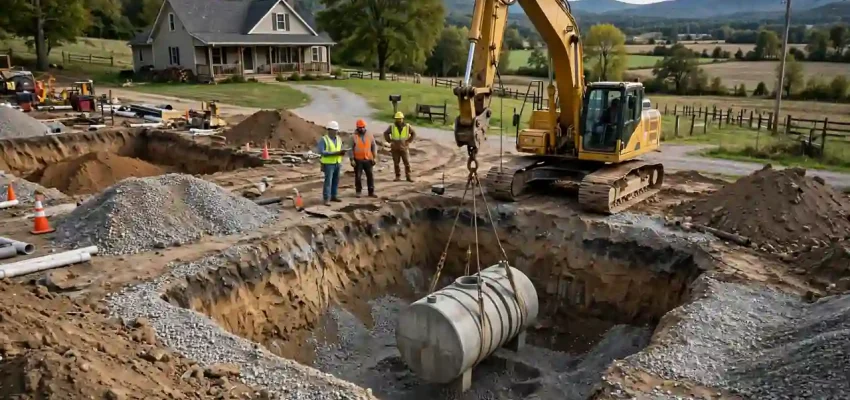

Few home problems inspire dread like a failing septic system. Slow drains throughout the house, sewage odors in the yard, suspiciously lush grass over the drain field, or — worst case — sewage backing up into the home. When repairs are no longer enough, replacement is the only fix, and it is one of the biggest checks a homeowner will ever write. What is septic system replacement cost in 2026, and how do you keep this project from spiraling?
According to 2026 Angi and HomeAdvisor data, a full septic system replacement averages about $8,000 nationally, with most projects landing between $3,500 and $12,500. Basic conventional systems can cost as little as $3,000, while engineered aerobic or mound systems in difficult soil can exceed $20,000. This guide covers 2026 prices by system type, every cost component from perc tests to permits, the signs that replacement (not repair) is the right call, and how to hire the right installer.
Average Septic System Replacement Cost in 2026
The national numbers are well documented. HomeAdvisor’s 2026 data puts the average septic system installation at about $8,016, with most projects falling between $3,590 and $12,463. Angi’s figures align closely: an average near $8,039 with a typical range of $3,600 to $12,485. For tank-and-drain-field replacement specifically — the most common “full replacement” scenario — expect $5,000 to $12,000 depending on drain field type and size.
Septic pricing is intensely local: soil, water table, lot size, county regulations, and installer distance all move the number. Rural counties with sandy soil sit at the low end; clay soil, high water tables, and strict regulations sit at the high end. Always budget with local quotes, using national figures as a sanity check.
Septic System Replacement Cost by System Type
The type of system your property requires is the single biggest price determinant — and you do not get to choose freely. Soil conditions, water table depth, and local codes dictate which systems are legal on your lot.
- Conventional (anaerobic/gravity): $3,000–$8,000. The standard tank-plus-drainfield system in soil that percs adequately. Cheapest and simplest — if your lot qualifies, this is what you want.
- Chamber system: $5,000–$12,000. Uses plastic chambers instead of gravel in the drain field; good for smaller lots and high water tables.
- Sand filter system: $7,000–$18,000. Wastewater filters through sand before reaching the drain field; used where soil treatment capacity is limited.
- Drip distribution: $8,000–$18,000. Shallow drip lines dose the field slowly; works in difficult soils with minimal excavation depth.
- Aerobic treatment unit (ATU): $10,000–$20,000. Uses oxygen and pumps to treat waste like a mini treatment plant; required in many environmentally sensitive areas.
- Mound system: $10,000–$20,000. An engineered raised bed for high water tables or shallow bedrock.
- Evapotranspiration: $10,000–$15,000. For arid climates where evaporation handles the effluent.
The pattern is clear: the worse your soil and water conditions, the more engineered (and expensive) the required system. This is why the perc test — the soil’s ability to absorb water — is the first dollar worth spending on any septic project.
Cost Components: Where the Money Goes
Perc / soil testing: $700–$2,000
The percolation test measures how fast your soil absorbs water and determines which system types your lot can legally use. Some counties require engineered soil evaluations that push toward the high end. Skipping this step is not an option — no legitimate installer will quote a system without knowing what the soil allows.
Permits and design: $450–$3,500
Septic permits typically cost $450 to $2,300 depending on the county, and many jurisdictions require a licensed designer or engineer to stamp the system plans ($500–$1,500+). The full sequence — perc test, design, permit, inspection — commonly totals $800 to $3,500. Start the permit process early; approvals can take weeks.
The tank: $3,000–$10,000
A new tank alone (without drain field work) runs $3,000 to $10,000 installed, varying by material and size. Concrete tanks are the traditional choice and most affordable; fiberglass and polyethylene tanks cost more but resist corrosion and are lighter to install. Size follows bedrooms: a 3-bedroom home typically needs a 1,000-gallon tank, a 5-bedroom home 1,500 gallons.
The drain field: $5,000–$12,000
The drain field (leach field) does the actual wastewater treatment, which is why its size and soil conditions drive so much of the total. Replacing a drain field alone averages around $7,000. Larger fields cost more in materials and labor, and poor soil may require imported fill or engineered alternatives that multiply the price.
Excavation: $1,500–$6,300
Septic work is earthmoving work. If excavation is not bundled into the installer’s quote, budget $1,500 to $6,300 depending on depth, soil rockiness, access for equipment, and how much landscaping must be restored afterward. Tight lots with no equipment access cost more.
Labor: ~60% of the total
Installing a septic system is among the most labor-intensive residential projects — digging, setting tanks, laying field lines, backfilling, grading. Angi’s 2026 data puts labor at roughly 60% of project cost, averaging around $3,600 on a typical job. This is skilled, licensed work; the crew’s competence is worth every dollar.
Repair vs. Replacement: How to Tell Which You Need
Not every septic problem requires full replacement — repairs often cost a fraction. Here is how to read the signs.
Repair may be enough when: a single component has failed but the rest of the system is sound — a broken baffle ($300–$900), a damaged distribution box, a crushed pipe section, or a pump that died in an aerobic system. A professional inspection with the tank pumped and the field evaluated will tell you.
Replacement is likely when: the drain field is saturated and failing (sewage surfacing, persistent odors, lush stripes of grass over the field), the tank is structurally compromised (cracked concrete, collapsed baffles throughout), or the system is simply at end of life — conventional systems last 25 to 30 years with good maintenance, less without it. If your system is 30+ years old and showing symptoms, replacement is usually the honest answer.
Partial replacement is the middle path: if the tank failed but the field still percs well (or vice versa), you may only need one side replaced. A new tank runs $3,000 to $10,000; a new field averages $7,000. Always verify the surviving component is genuinely sound before committing to a partial job.
Signs Your Septic System Is Failing
Watch for: slow drains throughout the house (not just one fixture), gurgling sounds in plumbing, sewage odors indoors or in the yard, wet or spongy ground over the drain field, unusually green grass over the field, and any sewage backup. A single slow drain is usually a drain cleaning issue; whole-house symptoms point at the septic system. If you are on the fence, a plumber with septic experience can run a camera inspection and give you a straight answer.
Septic System Replacement vs. Connecting to City Sewer
Some homeowners with failing septic systems wonder whether connecting to municipal sewer is the better long-term play. Angi’s 2026 data puts sewer line installation on private property at an average of about $3,464 (typical range $1,422–$5,757), but the full cost of “going sewer” includes municipal tap and connection fees that can run $500 to $20,000 depending on the utility — plus trenching, the lateral line, and restoration.
The comparison: a new septic system costs $3,500 to $12,500+ with no monthly bill; a sewer connection may cost $2,000 to $25,000+ all-in plus a monthly bill forever. If your property is far from the nearest sewer main, extension costs usually kill the sewer option — get the tap-fee quote first. Our sewer line replacement guide covers the construction side of that math.
How to Hire a Septic Installer (and Avoid Disasters)
Septic installation is regulated, permitted, skilled work — this is not a job for the cheapest bidder found on a whim. Start with your county health or environmental department: they maintain lists of licensed installers and can tell you exactly which permits and inspections your project needs.
Get three written quotes from licensed septic contractors, and make sure each includes the same scope: perc test coordination, engineered design, permits, tank size and material, drain field specifications, excavation, backfill and rough grading, and the inspection schedule. Verify the license with the county, ask for references from jobs completed 2–3 years ago (problems show up with time), and confirm who handles the permit paperwork — reputable installers manage it; shady ones ask you to pull the permit yourself.
Red flags: quotes without a site visit and perc test, pressure to pay large deposits upfront (10–30% is normal; 50%+ is not), no written warranty on workmanship, and any suggestion to skip permits. A failing septic system is also a health and environmental hazard, so unpermitted work can bring fines that dwarf any savings. The diligence you would use finding a reliable plumber applies here with even higher stakes.
Maintenance: Making Your New System Last 30 Years
A new septic system is a 25-to-30-year asset — if you maintain it. Pump the tank every 3 to 5 years ($300–$600 per pumping); this single habit prevents most premature field failures. Conserve water: the less water entering the system, the longer the field lasts — fix running toilets promptly (see toilet installation costs if a replacement is due) and spread laundry loads across the week. Never flush wipes (even “flushable” ones), grease, or chemicals. Keep vehicles, structures, and deep-rooted trees off the drain field, and divert roof and surface water away from it — good drainage around the whole property, the same principle behind basement waterproofing, protects the field too.
Household water habits matter: a water softener installation changes backwash volumes, garbage disposals add solids load, and bathroom plumbing or kitchen sink additions change daily flow — size and maintain accordingly, ideally with a general contractor who understands septic capacity limits.
Financing a Septic Replacement
At $8,000 average, many homeowners need financing: home equity loans or HELOCs (usually cheapest), personal loans, or contractor financing. For qualifying rural properties, USDA grants and low-interest loans cover septic replacements, and some counties offer programs for failing systems near sensitive waterways — ask your county health department before borrowing commercially.
Frequently Asked Questions About Septic System Replacement Cost
How much does it cost to replace a septic tank and drain field?
In 2026, replacing both the tank and drain field typically costs $5,000 to $12,000, with the national average for a full system replacement near $8,000. Engineered systems (aerobic, mound) run $10,000 to $20,000.
How long does a septic system last?
A well-maintained conventional system lasts 25 to 30 years. Regular pumping every 3–5 years, water conservation, and keeping the drain field clear are what get you to the far end of that range.
Can I replace a septic system myself?
Effectively no. Septic installation requires permits, engineered designs, licensed installers, and county inspections in virtually every US jurisdiction. DIY septic work is illegal in most places and can contaminate groundwater — with liability that follows the property.
Does homeowners insurance cover septic replacement?
Rarely. Standard policies exclude wear-and-tear and maintenance failures, which is what most septic replacements are. Sudden accidental damage (a vehicle crushing the field, for example) may be covered — check your policy.
How long does septic replacement take?
The physical installation typically takes 3 to 7 days. Permits, design, and perc testing add 2 to 8 weeks before work starts, so plan the project timeline around the paperwork, not just the digging.
Conclusion: Test First, Permit Early, Hire Licensed
Septic system replacement cost in 2026 averages about $8,000, but your number hinges on soil, system type, and local regulations — a conventional system on good soil can cost half what an engineered system on clay costs. Start with the perc test, get the permits moving early, collect three licensed quotes with identical scopes, and maintain the new system with regular pumping. Handle it in that order, and this once-in-a-generation project stays controlled instead of chaotic.